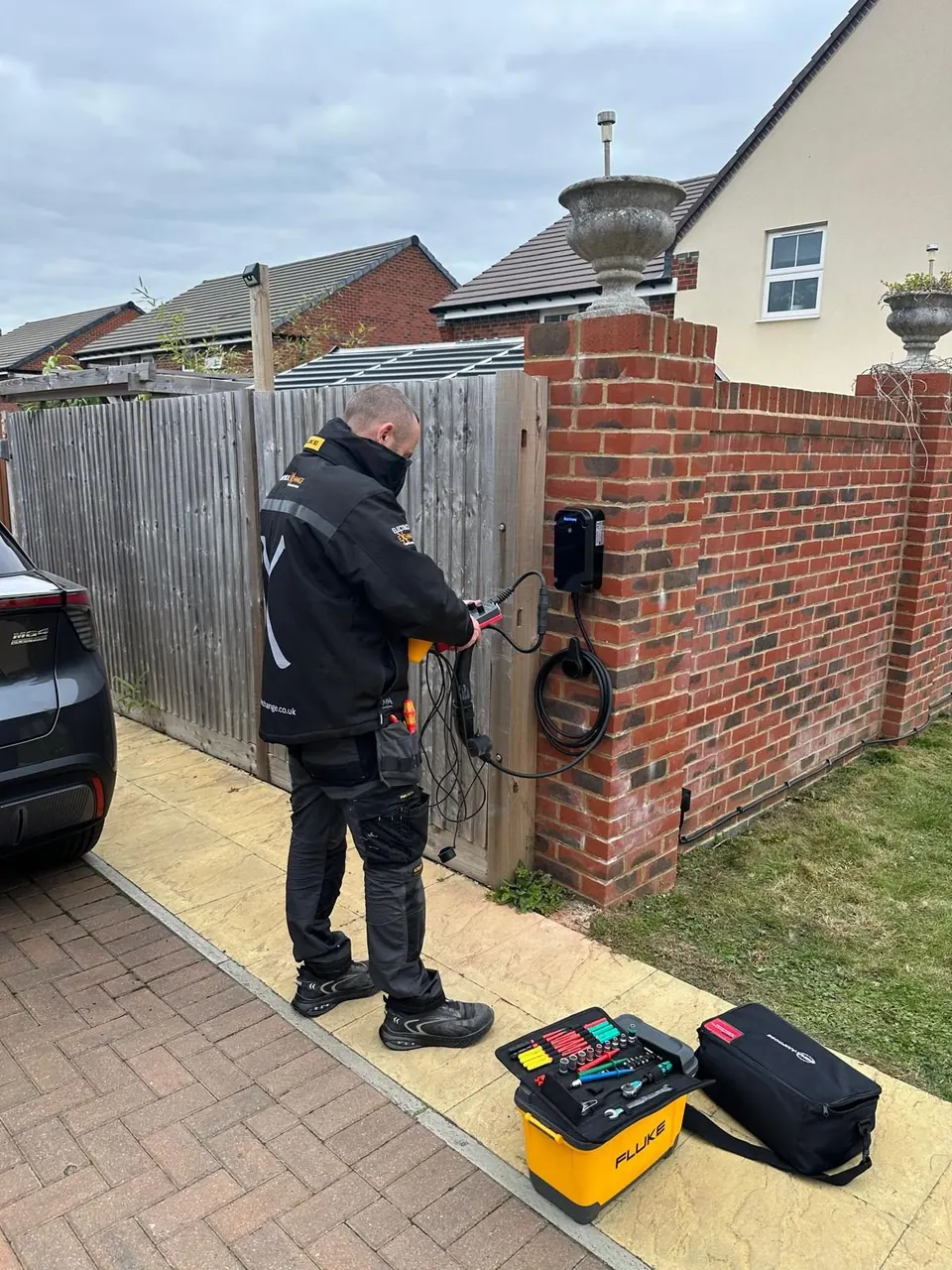
We have multiple jobs and works completed by Adam and the team and could not be happier with the work conducted, this has included a rewire of our property and most recently new lights fitted to the entrance of our house set on a PIR brilliant work and to a very high standard.
Fuse Board Replacement
A fuse board replacement swaps your old fuse box or worn consumer unit for a modern board with RCD and RCBO protection.
- MCS Certified
- NAPIT Registered
- TrustMark
- OZEV Approved
Replacing an Old Fuse Box or Consumer Unit
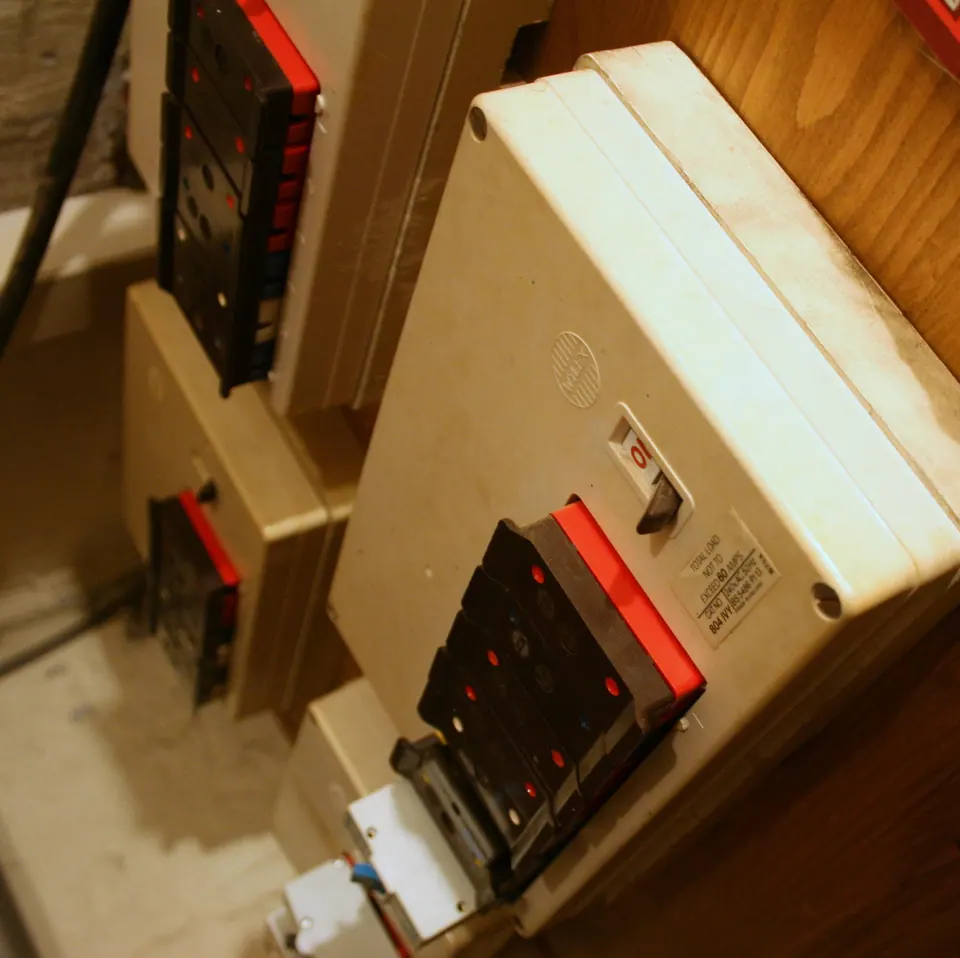
If your home still has an old fuse box, or a consumer unit showing signs of heat or damage, or one with no room left for another circuit, it may be time for a new board. The IET, which publishes the wiring regulations with BSI, notes that the same box has gone by many names: fuse box, fuse board, dis-board and now consumer unit. Whatever yours is called, it controls, distributes and protects every final circuit in the house. In the 1960s a board with a wooden back box and rewirable fuses was acceptable, and the requirements have changed a great deal since.
Installing and maintaining circuit breakers is one of the six electrical services we offer, and consumer unit upgrades are among the jobs we do most often, taking older boards up to today's safety standards with RCD and RCBO protection. All of it is done by our own in-house team rather than subcontractors. A new board renews the protection, not the cables behind it, so where testing shows the wiring itself is worn out, the better answer is a partial or full rewire.
Signs Your Fuse Board Needs Replacing
Damage and heat are the signs that can't wait. The IET's consumer guidance says a burning smell, excessive heat, smoke, or burning or charring at the consumer unit means the installation should be isolated immediately and an electrician consulted. The flood guidance from Electrical Safety First puts the caution plainly: switch off at the board only if it is safe to do so, and get an electrician's advice if it shows any sign of water, arcing or overheating. Smoke or flames mean getting everyone out and calling 999. A damaged board counts as an urgent electrical issue, which our 24/7 emergency service covers.
GOV.UK fire safety guidance lists other signs of dangerous or loose wiring: scorch marks, hot plugs and sockets, fuses that blow, circuit-breakers that trip for no obvious reason, and flickering lights. If your whole street has lost power, though, it's a power cut: report it online, or ring 105, which is free and puts you through to the local network operator.
Age alone isn't proof a board must go. Electrical Safety First's September 2026 guide to consumer unit replacement says a unit need not be replaced simply because it has rewirable or cartridge fuses or older circuit-breakers, or because it lacks an RCD, since there may be other ways to add that protection. A rewirable fuse holding oversized wire is different: the charity's coding guide lists that as potentially dangerous, code C2.

What a Modern Consumer Unit Holds
- IsolationMain SwitchTurns off the whole installation in one go. The IET notes it isolates rather than protects, and it's the switch for an emergency such as visible overheating.
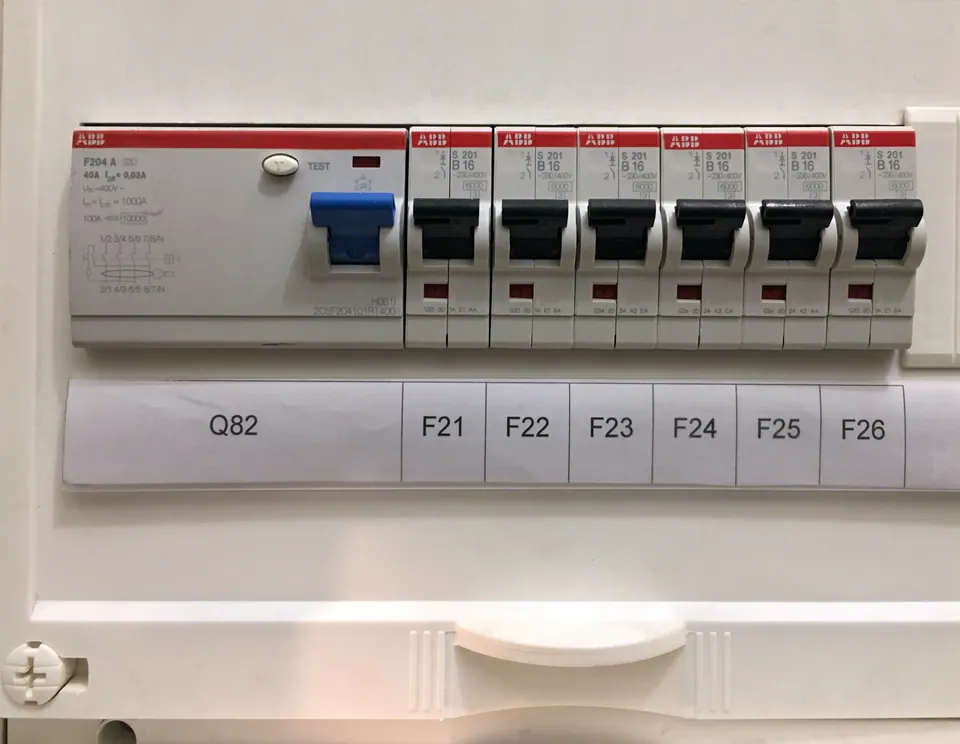
- OverloadCircuit-Breakers (MCBs)The modern successor to fuses, one per circuit and rated in amps, guarding against overload and short circuits. After tripping, a breaker is reset instead of rewired.
- ShockResidual Current Devices (RCDs)Rated in milliamps, so thousands of times more sensitive than a breaker, an RCD cuts the supply when it detects current leaking away. Splitting circuits across two RCDs stops one trip blacking out the house.
- CombinedRCBOsAn RCD and a circuit-breaker in one device, fitted circuit by circuit so each has its own protection against shock and overload.
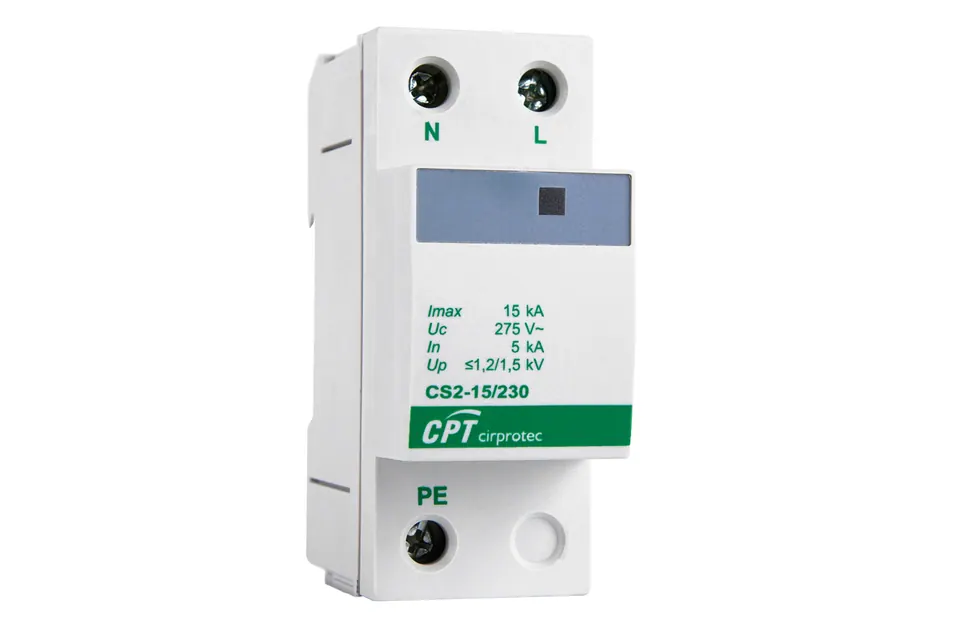
- SurgeSurge Protection (SPDs)Shields the wiring and connected electronics from transient overvoltages, such as those caused by lightning striking a nearby overhead line. A combined Type 1 and 2 device usually sits in the consumer unit.
- ArcingArc Fault Detection (AFDDs)Analyses the circuit's waveform for the signature of arcing from loose connections or damaged cable, then cuts that circuit, which could prevent a fire. Arcing can exceed 6,000°C.
Plastic Boards, Metal Cases and Arc Faults
From January 2016, the wiring regulations have required consumer units in homes to be made of non-combustible material, which is why a modern board has a metal enclosure. The IET explains the aim: to contain any fire within the enclosure and remove the plastic as extra fuel. A plastic unit with a deficiency such as a loose connection can burn and release toxic gases, with more severe consequences on an escape route such as a hallway or under the stairs.
The rule isn't retrospective. Electrical Safety First says a board need not be replaced just because its case is plastic, and its August 2026 coding guide marks a plastic board C3, improvement recommended, only where it sits under a wooden staircase or on the sole escape route; anywhere else it isn't coded at all. Arc fault detection devices work on the circuits rather than the case. BS 7671 requires them on socket circuits up to 32A in high-rise residential buildings, houses in multiple occupation, purpose-built student accommodation and care homes, and recommends them elsewhere. The IET adds that they're unlikely to fit an existing board, so adding them usually means a new one. Our guide to arc fault detection devices goes into the detail.
What a New Board Has To Meet Today
Replacing a consumer unit counts as new work, so the board has to be designed, installed and tested to the current edition of BS 7671, even though the existing circuits it feeds don't have to be brought up to date. Today that means BS 7671:2018+A4:2026, published on 15 April 2026, which after a six-month transition became the only version of the standard on 15 October 2026.
Inside the board, IET guidance for householders says that generally every circuit in a home needs additional protection from an RCD. Electrical Safety First's replacement guide recommends Type A RCBOs, or enough Type A RCDs, on all circuits, and explaining the benefits of a mains-powered fire alarm system if the home has none. Surge protection became the default in Amendment 2 in 2022: it's required where an overvoltage could cause serious injury or loss of life, or significant financial or data loss, and in other cases unless the owner declares any loss or damage tolerable and accepts the risk. Our guide to surge protection devices covers that choice.
Planning for a Charger or a Second Supply
A car charger, solar panels or a home battery all put new demands on the board. BS 7671 gives each EV charge point its own final circuit, with 30mA RCD protection and protection against DC fault current unless the charger provides it, which is why fitting a home charger starts with a look at your consumer unit and supply capacity. Before any alteration, the regulations also need the rating and condition of existing equipment, including the network operator's, to be adequate for the extra load, and Electrical Safety First's guide says a board with spare capacity for future circuits, such as solar PV, EV charging and battery storage, should be considered where practical.
Solar and batteries add a second source of supply, so current can flow through the board in either direction. Amendment 3, issued on 31 July 2024, added a regulation on unidirectional and bidirectional protective devices, and BEAMA, the electrotechnical trade association, warns in a 2024 bulletin that connecting a supply to the load terminals of a one-way device can leave its RCD function permanently inoperable, with no sign that it has stopped working. Amendment 4 adds a whole new chapter on stationary batteries, and the IET notes that EV charging and heat pumps have made surges much more likely in homes than they once were.
Building Regulations and Your Certificates
In England, Part P makes a consumer unit change notifiable: regulation 12(6A) of the Building Regulations 2010 lists it alongside new circuits and work around baths and showers. An electrician who belongs to a competent person scheme can self-certify it, after which the installer or their scheme has 30 days from completion to send you a Building Regulations compliance certificate and tell building control. Otherwise building control must hear about the job before it starts, unless a registered third-party certifier is appointed, and it issues its own certificate once satisfied. Where a board has to be replaced as an emergency repair, that notice can follow as soon as reasonably practicable after work starts.
On top of that compliance paperwork, the BS 7671 side of the job ends with an Electrical Installation Certificate, including schedules of inspection, circuit details and test results, which should note any defects left on the reconnected circuits. Keep it with your house papers. For a planned change, Electrical Safety First strongly recommends a condition report on the existing wiring beforehand, or at the very least a pre-work survey, because a circuit with a dangerous defect must not be reconnected to the new board until it is put right.
Steps in a Fuse Board Replacement
- SURVEY 1
Check the Board, Supply and Circuits
After a free assessment, we give you a detailed, fixed quote, with no hidden extras and no pressure to sign on the spot. Before the board is changed, the existing board, earthing, bonding and meter tails are checked, known faults are discussed and the circuits to be reconnected are tested.
- BEFORE THE DAY 2
Fix Faults and Arrange Isolation
Any defect that would be dangerous, or would trip a new RCD, is put right first, or that circuit stays disconnected. If there's no isolating switch ahead of the board, the network operator is asked to withdraw its cut-out fuse.
- ON THE DAY 3
Power Off While the Board Is Changed
With the supply isolated, the house is without power while the old board comes out and the new one goes in. Each circuit is reconnected to its own protective device and labelled.
- AFTERWARDS 4
Test and Hand Over
Every RCD is tested with an instrument and with its own test button, alongside continuity, insulation resistance and loop impedance checks, before your certificates are issued. The IET advises pressing each RCD's test button every six months.
Recent Electrical Installations
Photographed by our team, on the job.

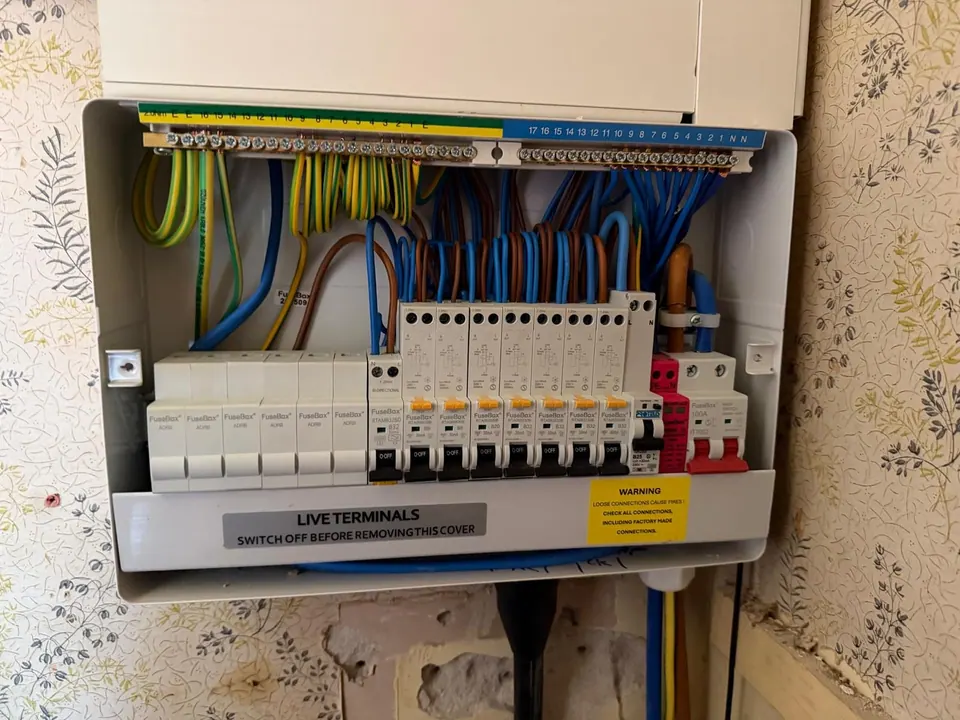
Consumer unit upgradeA new FuseBox consumer unit, cover off for testing.See the gallery
What our customers say
5.0 on Google from 23 reviews
Reviews 1–2 of 11
Installed new consumer unit in old house and corrected many faults worked tirelessly for 4 days straight rewiring where necessary, changing sockets earthing system.
Full garden lighting project was completed by Electrical Exchange. Installation of armoured cable, outdoor sockets, down lights, up lights, tree lights and rope lighting around patio. … I would call Adam a perfectionist with his neat and tidy workmanship.
Installed my EV charger and replaced the consumer unit to a very high standard. Professional, tidy, punctual, and took the time to explain everything clearly.
Adam from Electrical Exchange was punctual, professional and completed our electrical work to a high standard. He was friendly and explained everything clearly and he left everything clean and tidy.
Installed a sub-board for an air con unit I was installing…Prompt & polite, works clean & tidy.. highly recommend Adam and his team
I have them as my go to people for various needs around my old outdated Victorian house which has needed that more modern touch.
Adam and his team were great. He was on time, tidy and did the job well. There was a problem (not of his making) that he persisted with and managed to solve.
Great company and excellent service from Adam
5 Star service good prices and efficient working practises
Reliable service competitive prices hard working peoplie, Amazing service👍🏽
Fuse Board Replacement: What To Know
A starting point - get in touch if your question isn't answered here. See every answer
No. Electrical Safety First's guidance is that there's no legal requirement to bring an existing installation up to current standards, and its inspection coding guide lists rewirable fuses that still give adequate protection among the myths rather than the faults. Condition is what matters, and a periodic inspection is how you find it out.
A fuse box protects each circuit with a fuse that must be replaced, or rewired, once it blows. Consumer units took over from the mid-20th century with circuit-breakers you can reset, and a modern one adds RCD protection against electric shock, plus surge and arc fault protection where they're fitted.
A new RCD can show up faults an old fuse box had no way of detecting, such as current leaking to earth from damaged cable or a faulty appliance. That's why Electrical Safety First wants anything that would cause unwanted RCD tripping found and fixed, or that circuit left disconnected, before the board is changed.
We'd strongly advise against it. It's notifiable work, so a homeowner doing it would have to tell building control before starting and pay for it to be inspected, and it must still be tested to BS 7671. Electrical Safety First recommends using a registered electrician for any electrical installation work in your home.
Only when the report calls for it. In England, landlords must complete any remedial or further investigative work, meaning C1, C2 and FI items, within 28 days or any shorter period the report sets. A C3 means improvement recommended: GOV.UK's November 2025 guidance says landlords don't have to make it, though doing so improves safety.
Rather talk it through?
Speak to the team who'd do the work - no sales reps, no pressure.
01202 117005 Request a FREE Home SurveyGuides from the team
AFDDs explained: does your home need an arc fault detection device? (2026)An AFDD cuts a circuit off when it detects dangerous arcing. BS 7671 requires them in HMOs and a few other buildings, and recommends them in other homes.23 October 2026
Surge protection devices: does your home need an SPD? (2026)A surge protection device (SPD) diverts voltage spikes to earth. When the wiring rules expect one in your home, when you can say no, and what it can't do.23 October 2026
Can a handyman do electrical work? What the law allows in England (2026)A handyman can do some electrical work in England, but new circuits, consumer unit changes and work near a bath or shower are notifiable under Part P.24 October 2026
Electricians near you
Based in Christchurch, covering Dorset and Hampshire. Pick your town for local detail, or see the map.
- Christchurch electriciansour base
- Highcliffe electricians≈ 1.6 miles from our unit
- Electricians in New Milton≈ 4 miles from our unit
- Electricians in Bournemouth≈ 6 miles from our unit
- Electricians in Ferndown≈ 8 miles from our unit
- Electricians in Ringwood≈ 8 miles from our unit
- Electricians in Lymington≈ 9 miles from our unit
- Poole electricians≈ 10 miles from our unit
- Electricians in Wimborne≈ 11 miles from our unit
- Electricians in Fordingbridge≈ 13 miles from our unit
- Electricians in Dorsetevery town we cover
- Every area we coverthe coverage map
Other Services
Choose a service for how it works and the questions people ask us.