AFDDs explained: does your home need an arc fault detection device? (2026)
An AFDD cuts a circuit off when it detects dangerous arcing. BS 7671 requires them in HMOs and a few other buildings, and recommends them in other homes.
Electrical ExchangePublished · Updated · 8 min read


The quick answer
An AFDD, or arc fault detection device, sits in your consumer unit and switches a circuit off when it detects dangerous arcing from a loose connection or a damaged cable, which circuit breakers and RCDs aren't designed to catch. Under BS 7671:2018+A4:2026, AFDDs are required on socket circuits up to 32 A in high rise residential buildings, HMOs, purpose-built student accommodation and care homes, and recommended in all other premises, including ordinary homes. The rule isn't retrospective, so an older installation without them isn't necessarily unsafe, but a new consumer unit or new circuits are the natural time to add them.
An AFDD, short for arc fault detection device, sits in your consumer unit and switches a circuit off when it detects dangerous arcing: electricity jumping across a loose connection or a damaged cable. Under the current IET Wiring Regulations, BS 7671:2018+A4:2026, AFDDs are required on socket circuits in a few types of building and recommended in every other home.
Consumer unit upgrades are one of our most common jobs, so here’s what our electricians in Christchurch want you to know before you decide.
What an arc fault is: series and parallel
An arc is electricity crossing a gap, through air or damaged insulation. It creates intense heat and burning particles that can ignite whatever is nearby: BEAMA, the electrotechnical industry’s trade association, says arc temperatures can exceed 6,000 °C.
- Series arcs form along one conductor, at a loose terminal or a crushed or broken cable. The current still passes through the load, so it stays too low to trip a fuse or circuit breaker.
- Parallel arcs jump between two conductors, line to neutral or line to earth, where insulation is damaged: by a nail or screw, by rodents, or by age and heat.
MCB vs RCD vs RCBO vs AFDD: what each one catches
A circuit breaker (MCB) trips on an overload or a short circuit, and an RCD on current leaking to earth. A series arc does neither, and a line-to-neutral arc comes in short bursts generally too low, overall, to trip an MCB, without leaking to earth. An RCD will usually catch an arc to earth, though BEAMA notes that isn’t guaranteed.
| Device (product standard) | Trips on | Series arc | Arc, line to neutral | Arc, line to earth |
|---|---|---|---|---|
| MCB (BS EN 60898) | Overloads and short circuits | No | Generally not | No |
| RCD (BS EN 61008) | Earth leakage | No | No | Usually |
| RCBO (BS EN 61009) | Both, in one device | No | Generally not | Usually |
| AFDD (BS EN 62606) | Dangerous arcing, from 2.5 A | Yes | Yes | Yes |
AFDDs fill that gap: in BEAMA’s words, they’re “designed to detect low level hazardous arcing that circuit breakers, fuses and RCDs are not designed to detect”. They come standalone or combined with an MCB, an RCCB or an RCBO. A combined AFDD/RCBO gives a circuit overcurrent, earth leakage and arc fault protection in one device. It doesn’t need its own surge protection, BEAMA says, though BS 7671 decides whether your installation does: see what a surge protection device does.
Good to know An RCD can catch most arcs to earth, but an arc along a conductor or between line and neutral needs an AFDD to spot it.
How an AFDD tells a dangerous arc from a harmless spark
An AFDD’s electronics analyse the shape of the current, looking for the high-frequency noise arcing adds to the 50 Hz supply and judging how long and how irregular each arc is. Normal sparks, from a switch or a motor’s brushes, are short or regular, so AFDDs are designed and tested to ignore them, and the normal running of vacuum cleaners, drills and dimmers, while still catching a real fault. BS EN 62606, the AFDD product standard, sets these maximum trip times:
| Arc current | Maximum trip time |
|---|---|
| 2.5 A | 1 second |
| 5 A | 0.5 seconds |
| 10 A | 0.25 seconds |
| 16 A | 0.15 seconds |
| 32 A and 63 A | 0.12 seconds |
Below 2.5 A, an AFDD doesn’t have to trip on a series arc; BEAMA says an arc that small doesn’t give off enough power to cause ignition.
AFDDs aren’t a cure-all, and BEAMA says so. A connection that’s loose or clamped on insulation can overheat without arcing, and an AFDD won’t react until sustained arcing starts. They’re “not a substitute for good installation practice”.
Where BS 7671 requires an arc fault detection device
The 2018 edition only recommended AFDDs. Amendment 2 (2022) made them a requirement in some buildings, under Regulation 421.1.7, for single-phase AC final circuits supplying socket-outlets rated up to 32 A:
- Required (“shall”) in high rise residential buildings, houses in multiple occupation (HMOs), purpose-built student accommodation and care homes.
- Recommended (“should”) in all other premises, including ordinary houses and flats.
Amendment 2’s note assumed the first group, then called higher risk residential buildings, to be over 18 m tall or more than six storeys, whichever came first. GOV.UK defines an HMO as a home where at least 3 tenants, forming more than 1 household, share a toilet, bathroom or kitchen.
Good to know Amendment 4 renamed the first group from “higher risk” to “high rise” residential buildings; the places where AFDDs are required stayed the same.
What Amendment 4 (2026) changed
BS 7671:2018+A4:2026 was published on 15 April 2026, and since the previous version was withdrawn on 15 October 2026, it must now be used.
- Amendment 3 (July 2024) left the rule alone. It added two definitions and one regulation, on bidirectional and unidirectional devices.
- Amendment 4 renamed the first category from “higher risk” to “high rise” residential buildings, avoiding confusion with the Building Safety Act 2022’s higher-risk buildings, which for occupied buildings means at least two residential units and at least 18 metres or 7 storeys. BEAMA’s briefing says where AFDDs must be used hasn’t changed; elsewhere they remain recommended.
- EV charger circuits are clarified. Regulation 722.421.1.7.201 says AFDDs aren’t required on circuits supplying EV charging equipment to the BS EN 61851 series with sockets or connectors to BS EN IEC 62196-2.
Not retrospective: what it means for an older consumer unit
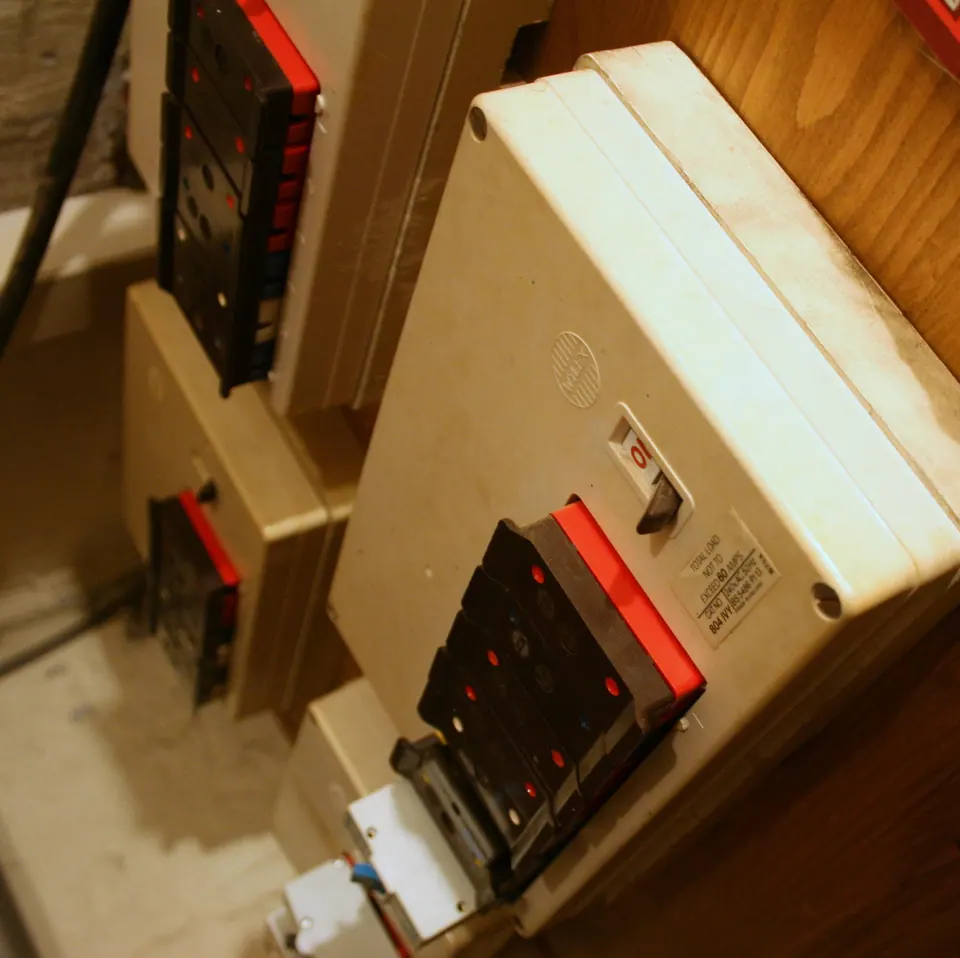
The introduction to Amendment 3 (2024) says installations put in under earlier editions “may not comply with this edition in every respect”, which “does not necessarily mean that they are unsafe for continued use or require upgrading”. The IET’s Wiring Matters (April 2026) adds that upgrading may improve safety, “but it is not a requirement”.
The regulations do apply to new work, including additions and alterations. New circuits, rewiring a house or a new consumer unit are designed to the edition in force, so that’s when the AFDD decision gets made.
AFDDs on an EICR: an observation, or a C3
On its own, a missing AFDD won’t make an Electrical Installation Condition Report unsatisfactory. Electrical Safety First’s Best Practice Guide 4 (Issue 7.4, August 2026, written to Amendment 4) treats it as:
- C3, “improvement recommended”, in high rise residential buildings, HMOs, purpose-built student accommodation and care homes;
- an observation anywhere else: worth noting, but not a non-compliance and not given a code.
GOV.UK’s guidance for landlords in England (1 November 2025) says a C3 doesn’t need remedial work for a report to count as satisfactory. If yours is due, an inspection with a full written report shows where you stand; our guide to how long an EICR lasts covers how often.
HMO landlords in Bournemouth, Christchurch and Poole
BCP Council requires a licence, lasting up to 5 years, for any HMO rented to 5 or more people, and its application asks for up-to-date electrical installation inspection and test certificates, alongside fire detection, emergency lighting and gas certificates and a fire risk assessment.
In an existing HMO, a missing AFDD is a C3, not a fail. But any new socket circuit you add is new work in a building where BS 7671 says AFDDs shall be provided.
Fitting AFDDs to your existing consumer unit
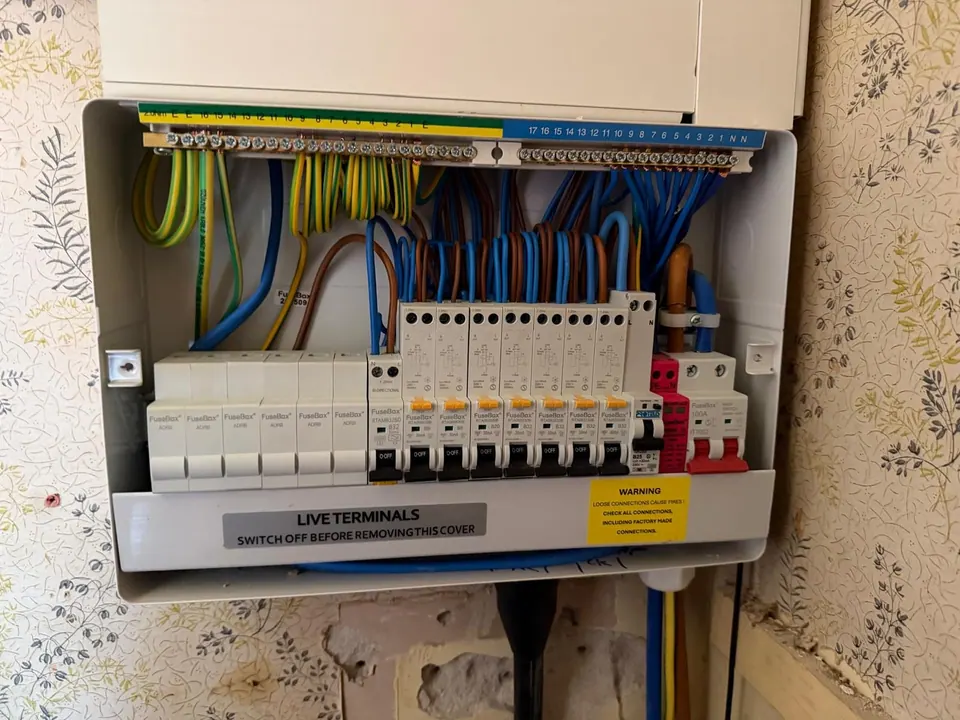
A consumer unit is an assembly under BS EN 61439, and BEAMA’s guidance is that only devices its maker declares suitable go into it. Three things decide whether yours can take AFDDs:
- Compatibility. The IET advises checking with the manufacturer that another maker’s device is suitable and compatible; Electrical Safety First’s coding guide gives unverified mixed-brand components in a consumer unit a C3, or a C2 (“potentially dangerous”) where there are signs such as heat damage or a modified enclosure.
- Space. Sizes aren’t standardised: one manufacturer lists an AFDD/RCBO three modules wide and now also makes single-module ones.
- Heat. AFDDs give off some heat, which the board maker’s current ratings and derating must allow for.
Where your board can’t take them, AFDDs come with a consumer unit upgrade. In England, replacing a consumer unit and adding a circuit are both notifiable under Part P (2013 edition), and any work inside your consumer unit, adding AFDDs included, is a job for an electrician, not DIY.
Good to know Only AFDDs that your consumer unit’s maker lists as suitable should go into it; where there’s no compatible device or no room, the answer is a new board.
Nuisance tripping, and testing your AFDDs
BS EN 62606 includes tests to stop AFDDs tripping on typical loads such as motors, switch-mode power supplies and dimmed lighting. One manufacturer acknowledges that a new appliance with an unfamiliar waveform could still trip its devices, and offers software updates for that.
After a trip, note what the AFDD’s indicator shows; most have one, though codes vary by make. Dorset & Wiltshire Fire and Rescue Service lists circuit breakers that trip for no obvious reason among the signs of dangerous or loose wiring. For those, and for buzzing or crackling, Electrical Safety First’s advice is to have your electrics checked as soon as possible.
- Smoke or fire: get out, stay out and call 999.
- Everything off, nothing tripped: it could be a power cut. 105 is free and connects you to your local network operator.
- Urgent electrical problems: we provide 24/7 emergency response for electrical issues.
AFDDs are tested with a button, automatically or both, and where there’s a test button, pressing it should trip the device. BEAMA’s guidance is to press it every six months on AFDDs without an automatic test; those with one check themselves at switch-on and at least daily. If yours has both, follow the manufacturer’s instructions, and if it won’t trip when tested, have it checked.
Good to know An AFDD won’t react to a loose connection until sustained arcing starts, so it adds to good wiring rather than replacing it.
So, does your home need an AFDD?
In most homes, no rule says you must have one: AFDDs are recommended, not required. We’d still weigh them up at a natural moment, such as replacing an older consumer unit, adding circuits or rewiring, especially where an arc would find something to burn: BEAMA points to timber frames, roof spaces and stud walls.
On any visit, from Christchurch to the homes we wire and inspect across Dorset, our electricians will flag anything that needs bringing up to current regulations.
For a straight answer on whether an arc fault detection device belongs in your home, book a free assessment. After it, we give you a detailed, fixed quote for any AFDD work, with no hidden extras and no pressure to sign on the spot.
Questions we're often asked
- Do I need an AFDD on every circuit?
- No. BS 7671's AFDD rule is about single-phase final circuits feeding socket-outlets rated up to 32 A, so lighting circuits sit outside it. Where AFDDs are fitted, BEAMA's guidance is that each one should sit at the origin of a single final circuit, rather than one device protecting several circuits or the whole board.
- What is the BS number for an AFDD RCBO?
- Two standards apply. The arc fault part is made to BS EN 62606, the AFDD product standard, and the RCBO part to BS EN 61009. Electrical Safety First's guidance for electricians completing certificates records a combined RCBO/AFDD device against BS EN 61009, noting that AFDDs should conform to BS EN 62606.
- Do AFDDs work on ring circuits?
- Yes, with one gap. On a ring final circuit, an AFDD covers parallel arcs in the ring itself, and series and parallel arcs in spurs and in anything plugged in. A series arc at a break in the ring isn't covered, but BEAMA says the current then reaches the sockets the other way round, so that fire risk is negligible.
- Does an EV charger circuit need an AFDD?
- Not if the charging equipment meets the standards Amendment 4 names: the BS EN 61851 series, with socket-outlets or vehicle connectors to BS EN IEC 62196-2. For those circuits, AFDDs aren't required. BEAMA's guide still describes AFDDs as suitable for protecting EV charging circuits, so you can have one if you'd prefer.
- Can I swap an AFDD that keeps tripping for an ordinary breaker?
- We'd advise against it, and it's a job for an electrician, not DIY. A breaker that keeps tripping is likely to be pointing at a fault in an appliance, a lead or the wiring, and a swap leaves that fault in place. Where AFDDs are required, such as in an HMO, it would also remove protection BS 7671 asks for.