Earth bonding and earthing explained: earth rods, TT supplies and what we check (2026)
Earthing gives fault current a safe path; earth bonding links metal gas and water pipes to it. Supply types, earth rods, EV charger rules and EICR codes.
Electrical ExchangePublished · Updated · 8 min read


The quick answer
Earthing gives a fault current a safe path to earth, so a fuse, circuit-breaker or RCD switches the faulty circuit off. Earth bonding connects the metal pipes that enter your home, usually gas and water, to the main earthing terminal, so two metal parts can't sit at dangerously different voltages during a fault. Most homes take their earth from the network (TN-S or TN-C-S, also called PME); a home on a TT supply relies on its own earth rod, backed by an RCD. An EICR checks both, and a missing main bond is coded C2, potentially dangerous.
Earth bonding and earthing are two halves of one safety system. Earthing gives a fault current a path to earth, so a fuse, circuit-breaker or RCD switches the circuit off. Earth bonding connects the metal pipes entering your home, usually gas and water, to the main earthing terminal, which Electrical Safety First says reduces the risk of a shock from touching two separate metal parts during a fault.
We’re electricians based in Christchurch; the rules are those of BS 7671:2018+A4:2026, the IET Wiring Regulations, the only current edition since 15 October 2026.
Earthing and earth bonding: what each one does
Electrical Safety First’s example is a faulty cooker: the fault current flows to earth through the protective conductors, the protective device in the consumer unit cuts the supply, and nobody touching the cooker gets a shock. Bonding tackles a different danger, two metal parts at different voltages during a fault, by reducing the voltage between them.
| Earthing | Main bonding | Supplementary bonding | |
|---|---|---|---|
| Connects | Circuits and metal-cased equipment to earth | Incoming metal pipes and structural steel to the main earthing terminal | Metal parts in one room, usually a bathroom, that can be touched together |
| Needed? | Yes: having no reliable earth is coded C2 | Where the metal brings in earth potential | Unless BS 7671 lets it be left out |
Main protective bonding to gas and water pipes
Regulation 411.3.1.2 of BS 7671 lists typical candidates for main bonding: water and gas installation pipes, other pipework and ducting, central heating and air conditioning, and exposed structural metalwork. The IET stresses each must first be an extraneous-conductive-part, “a conductive part liable to introduce a potential, generally Earth potential”, which usually means metal running outside and into the ground.
The IET puts the bond as close as practicable to where the pipe enters, preferably within 600 mm and before any branch; for gas, that’s the installation pipe after the meter. The connection should carry a “Safety Electrical Connection – Do Not Remove” label. Leave clamps and gas pipes alone, and if you smell gas, call the National Gas Emergency Service free on 0800 111 999 without touching any electrical switches, as SGN advises.
Plastic pipes: when bonding isn’t needed
Since the 18th Edition (2018), BS 7671 has said metal pipes with “an insulating section at their point of entry need not be connected to the protective equipotential bonding”. The IET says a plastic (MDPE) pipe “is unlikely to be considered an extraneous-conductive-part, but this must be verified”, since metal pipework can leave the house elsewhere and enter the ground. Needless bonding isn’t harmless either: the IET warns it can export fault currents, creating a shock risk at an outside tap. So if a supply pipe has been changed to plastic, let an electrician decide whether the old bond stays.
Good to know A plastic supply pipe can mean a bond isn’t needed, but the IET says that has to be verified, not assumed.
Supplementary bonding in bathrooms, and when it can be left out
Supplementary bonding links metal parts that can be touched at the same time, and the IET says it’s usually only needed in special locations such as a bathroom. Regulation 701.415.2 lets it be left out, where there’s suitable main bonding, if:
- every final circuit in the room meets the requirements for automatic disconnection,
- every final circuit in the room has 30 mA RCD protection,
- all extraneous-conductive-parts in the room are effectively connected to the protective equipotential bonding.
Otherwise it’s needed, and Electrical Safety First codes its absence C2. Bonding on every sink, tap and radiator probably dates from the 15th Edition (1981); the IET says the 16th Edition (1991) limited bonding to extraneous-conductive-parts.
TN-S, TN-C-S (PME) and TT: the three supply earthing types
Your earth comes from the network or from the ground at your home: the IET says a low-voltage supply will be TN-S, TN-C-S (PME) or TT. It calls PME “almost universally adopted” by UK network operators, while National Grid Electricity Distribution says TN-S is “now relatively rare” and TT “common within older properties”.
Around Christchurch, Bournemouth and Poole, Scottish and Southern Electricity Networks (SSEN) runs the network. It normally gives new connections a TN-C-S earth terminal, and “would not change the type of earthing currently in use” on an existing supply to a building under renovation.
How to tell which earthing you have, without touching anything
| Type | Where the earth comes from | What an electrician looks for |
|---|---|---|
| TN-S | A separate network earth, usually the cable’s metal sheath or armour | An earthing conductor connected to that sheath |
| TN-C-S (PME) | The network’s combined neutral and earth | An earth terminal linked to the incoming neutral |
| TT | Your own earth electrode, usually a rod | No network terminal; a conductor to the electrode |
Look, don’t touch: the cut-out is sealed, and SSEN calls the service cable “the cable that we maintain to your property”. Appearances mislead too. National Grid Electricity Distribution says an earth taken from a combined neutral-and-earth network, classed as TN-C-S, is common at existing connections, so a clamp on an old cable sheath doesn’t prove TN-S.
Your last EICR records the arrangement, and under regulation 28 of the Electricity Safety, Quality and Continuity Regulations 2002, the network operator must give a written statement of “the type of earthing system applicable to the connection” to anyone who can show reasonable cause. If the cut-out looks damaged, call 105 free, or 999 if there’s an immediate risk to life.
Earth rods and TT supplies
TT is used when the network doesn’t provide a TN earth or one can’t be used; the IET’s 2011 guidance cites a low-voltage overhead line, where the earth back to the source can’t be guaranteed.
An earth rod is “a simple and usually the most cost-effective” electrode, but a TT earth path usually can’t trip fuses or circuit-breakers in time, so an RCD must provide the shock protection. The IET points to BS 7671’s note that an electrode resistance above 200 ohms “may not be stable” as soil dries and freezes, and says most network operators want the electrode 2 or 3 metres from buried metalwork connected to a PME earth. A rod needs periodic inspection and testing, and striking buried services can cause serious injury, so it’s never a DIY job.
Good to know On a TT supply, your own earth rod, backed by an RCD, does the job a network earth terminal would otherwise do.
Why an EV charger on a PME supply needs extra protection
On PME, the network’s neutral also carries your earth. If that combined conductor, the PEN, breaks on the network, the IET explains, a voltage can develop between everything on the PME earth and the general mass of Earth, and outdoors, contact with Earth is always possible. So Regulation 722.411.4.1, as Amendment 1 (February 2020) worded it, says: “A PME earthing facility shall not be used as the means of earthing for the protective conductor contact of a charging point located outdoors or that might reasonably be expected to be used to charge a vehicle located outdoors unless one of the following methods is used”. Amendment 1 listed five methods; Amendment 2 (2022) deleted the three-phase one, leaving four:
- a low-resistance earth electrode that keeps the earth within 70 V if the PEN breaks,
- a device that disconnects the vehicle from the live conductors and earth within 5 seconds if the voltage between the protective conductor and Earth exceeds 70 V,
- on single-phase, a device doing so if the charger’s voltage leaves the range 207 V to 253 V,
- an alternative device that’s no less safe.
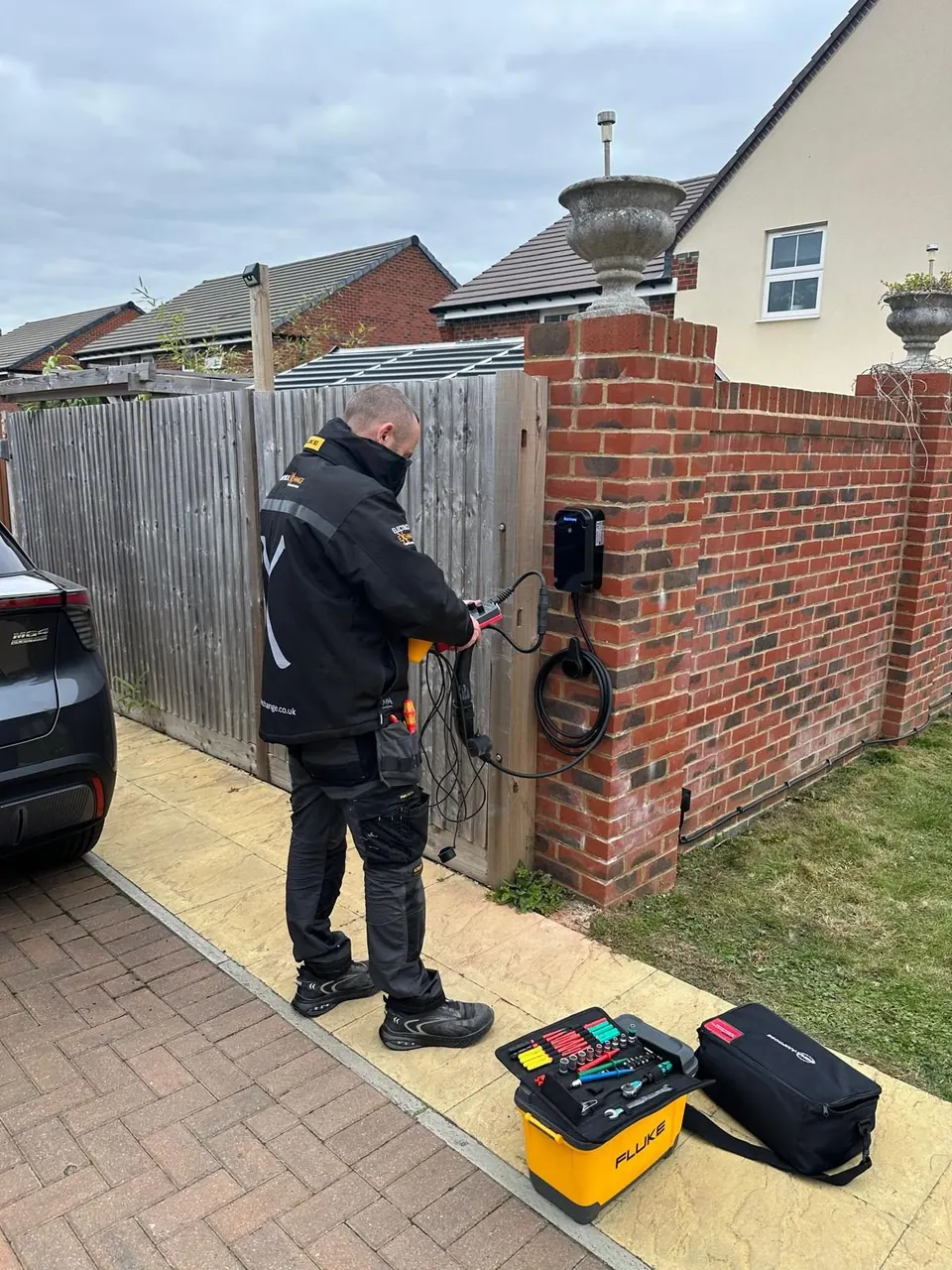
The regulation says that function “could be included within the charging equipment”, and myenergi, for one, says its UK zappi has built-in PEN fault protection. A separate TT rod for the charger may not suit either, a note in Amendment 1 warns, if it can’t be kept far enough from buried metalwork connected to the PEN. Electrical Safety First’s coding guide for Amendment 4 still codes an outdoor charger on PME that misses 722.411.4.1 as C3, so it’s a question for every home charge point installation.
Good to know An earth rod is only one of four ways to meet the PME rule for chargers, and some chargers build the protection in.
What an EICR records about earthing and bonding
The IET’s Amendment 4 form for a condition report on your electrics records your earthing type, any earth electrode’s type, location and resistance, the earthing and main bonding conductor sizes, and bonding to water, gas and oil pipes, structural steel and lightning protection. Typical codes from Electrical Safety First’s Best Practice Guide 4 (Issue 7.4, August 2026):
| Finding | Code |
|---|---|
| No reliable, effective means of earthing | C2 |
| A gas, oil or public water pipe used as the earth | C2 |
| No effective main bonding of metal services coming in | C2 |
| Main bonding conductor under 6 mm², or heat-damaged | C2 |
| Main bond inaccessible, or on branch pipework without assured continuity | C3 |
| Main bonding conductor below today’s size but at least 6 mm², no heat damage | Not coded |
| Missing “Safety Electrical Connection – Do Not Remove” label | Observation |
A C1 or C2 makes the report unsatisfactory; a C3 is advisory.
What we check before adding to your wiring
Electrical Safety First says that if you’re having any electrical work done, “your electrician must check that the earthing and bonding arrangements you have are up to the required standard”. So before we add to an installation, we look at where the earth comes from, the earthing conductor, the main bonds and their labels, and any bathroom bonding.
Replacing an old consumer unit is new work that must meet today’s edition, which is also when a surge protection device comes up. Earthing and bonding underpin all our electrical services, from repairs and lighting to rewiring and inspections, and our electrical and earthing work across Dorset.
When to call an electrician
Don’t disconnect, move or test earthing or bonding yourself. Electrical Safety First recommends a registered electrician for any electrical installation work, and our guide to whether a handyman can do electrical work is worth reading first. Call an electrician if:
- a bonding clamp is loose, corroded or unlabelled,
- someone has cut into or replaced a bonded pipe,
- a gas or water supply pipe has been changed to plastic,
- you’re planning an EV charger or a new consumer unit.
Earth bonding and earthing: the short version
Earthing gives fault current a way out; earth bonding keeps metal pipes from sitting at different voltages in a fault. Your supply is TN-S, TN-C-S (PME) or TT, and an EICR records and codes both. Unsure about your earth bonding? Ask us for a free quote and we’ll check your earthing and bonding on a visit.
Questions we're often asked
- Who looks after the earth terminal at my meter?
- If the network operator provided it, the operator does. National Grid Electricity Distribution, for example, says it maintains an earth terminal it has provided for the life of the installation, as far as practicable. On a TT supply there's no network terminal: the earth electrode is yours to provide and maintain, through your electrician.
- Does a kitchen sink or boiler pipework need bonding?
- Usually not. Electrical Safety First's coding guide lists missing bonding to metal sinks and baths, and to boiler pipework, as myths rather than faults, unless the metal brings in earth potential itself. The IET adds that a kitchen isn't a special location and a kitchen sink is an isolated piece of metal.
- Will every EV charger need an earth rod?
- No. On a PME supply, Regulation 722.411.4.1 gives four routes, and only one relies on a low-resistance earth electrode. Others use a device, which can be built into the charger, that disconnects the vehicle when it detects a fault on the supply. The regulation covers PME earthing, so it doesn't apply to a home whose installation is already TT.
- How often should an earth rod be checked?
- The IET says an earth electrode doesn't need maintenance as such, but it does need periodic inspection and testing to confirm it's still suitable, ideally planned for different times of year because soil conditions change with the seasons. An EICR records the electrode's measured resistance alongside its type and location.
- What is PNB earthing?
- Protective neutral bonding is an arrangement that Amendment 4 brought into BS 7671 for the first time. National Grid Electricity Distribution says it's common in rural locations where a pole-mounted transformer serves a single customer. NICEIC notes a supply to more than four consumers can't be PNB, and the new certificates have a box for it.