Looped electricity supply: why it can hold up an EV charger or battery (2026)
A looped supply means your home shares its service cable with a neighbour. Why SSEN checks it before an EV charger goes in, who pays and how long.
Electrical ExchangePublished · Updated · 8 min read


The quick answer
A looped supply is an older arrangement where your home and a neighbour's share one electricity service cable from the street. On its own it's safe, but the shared cable may not cope with a big new load in both homes. So before an EV charger goes in on a looped supply, the installer sends SSEN, the network operator for Bournemouth, Poole and Christchurch, a load check, and SSEN carries out any unlooping before the charger is fitted. SSEN says unlooping is usually free for a typical household supply of up to 100 A per phase, and your power is usually off for half a day or more while it's done.
A looped supply is an older way of connecting homes, where your house and a neighbour’s share one electricity service cable from the street. It’s safe as it is, but the shared cable may not cope with a big new load in both homes. So before an EV charger goes onto a looped supply, the installer must ask SSEN, the network operator for Bournemouth, Poole and Christchurch, to check it, and any unlooping is done first. For a typical home, SSEN says that’s usually free.
We’re based in Christchurch, fitting chargers and batteries across Dorset and Hampshire. Here’s what a loop means for your plans.
What a looped supply is
A service cable brings electricity from the network to your cut-out, the network operator’s main fuse in or near your meter box. On a looped supply, SSEN explains, the cable enters one property first, and a second cable runs from that property’s meter position to the one next door. SSEN no longer installs them, but many remain, particularly in older terraced and semi-detached houses.
A loop can link more than two homes. The Energy Networks Association (ENA), the voice of the network operators, says some areas have five or six homes looped in a daisy chain, from the bottom of the cut-out or sometimes the top. SSEN’s 2026 customer guide shows overhead loops as well as underground ones.
Good to know A loop can run overhead or underground, and can link a chain of homes rather than just two.
Why older streets have looped supplies
SSEN says homes on loops were connected that way when they were built, in the second half of the 20th century, to save money and because greater electricity use wasn’t expected then. The ENA says loops can turn up in any home, but are often found on 1970s and 1980s housing estates, in rural areas and in terraced housing. As interest in EVs, heat pumps, solar panels and air conditioning has grown, SSEN says, so has demand for unlooping.
Looped supplies around Bournemouth, Poole and Christchurch
SSEN runs the network here, from the £12 million Christchurch-to-Boscombe programme it began in September 2024 to the 32 km circuit serving Poole and Shaftesbury that it finished upgrading in 2022. The kinds of homes loops are linked with are common locally:
| Local figure | Number | Source |
|---|---|---|
| Households in semi-detached houses, BCP, 2021 | 30,018 (17.3%) | Census 2021 |
| Households in terraced houses, BCP, 2021 | 17,150 (9.9%) | Census 2021 |
| Properties built 1945 to 1999, BCP, 31 March 2026 | 91,390 of 190,550 (about 48%) | Valuation Office Agency |
| Homes still on a looped supply, across SSEN’s areas, July 2026 | Around half a million (16%) | SSEN |
None of that tells you whether your house is looped: SSEN’s records can, and your cut-out can give a clue. SSEN’s first unlooping pilot, for up to 1,200 homeowners, is in Swindon, Southampton, Lee-on-Solent and Ash in Surrey, and it’s developing an AI-led tool so anyone in its areas can check. Meanwhile, it asks people applying for a charger or heat pump who think they’re on a loop to say so.
Connect and notify: why SSEN checks a looped supply first
Whenever an EV charger or heat pump is added to an existing home, the network operator must be told. The ENA’s process has two routes:
- Connect and notify. If total maximum demand, new load included, is 60 amps or less per phase and the supply is known to be adequate, the installer fits the equipment and notifies the network operator within 28 days.
- Apply to connect. Otherwise the installer applies first and waits. SSEN calls this a load check, and a looped supply must have one before installation, to decide whether unlooping is needed.
The reason is the shared cable. SSEN says a looped service may not handle extra demand for both homes, which can leave appliances working poorly or even cause power cuts.
| Your situation | Route with SSEN | What happens |
|---|---|---|
| Own service cable, demand 60 A or less, no safety concerns | Connect and notify | Charger fitted, then SSEN notified within 28 days |
| Total demand above 60 A | Load check (apply to connect) | Installer waits for SSEN’s approval before fitting |
| Looped supply | Load check before installation | SSEN decides on unlooping, and any unlooping comes before the charger |
| EV charger and heat pump together | Apply to connect | The network operator considers power quality first |
| Damaged cut-out or exposed cables | Report it before anything is installed | SSEN: stay away and call 105 |
Why a battery raises the same question
SSEN’s looped-service page names EV chargers and heat pumps, but a battery adds load too: it can charge from the grid during cheap off-peak periods, and the ENA says network operators treat storage as both demand and generation.
The wiring rules agree. The ENA quotes Regulation 132.16 of BS 7671, the IET Wiring Regulations: no addition or alteration should be made unless the rating and condition of existing equipment, “including that of the distributor”, will be adequate, whatever the appliance. A battery also goes through the G98 or G99 process with the network operator. If you’re weighing up adding a home battery, with or without panels, mention a possible loop early.
Who pays for unlooping
SSEN’s looped-service page, as read on 23 October 2026, says it can often unloop a supply free of charge. That’s usually so with a typical household supply, up to 100 A per phase with a meter, when you need unlooping to install something like an EV charger or heat pump. Its 2026 customer guide puts it plainly: SSEN pays to remove the loop and lay a direct cable from the main network.
Charges can apply if you ask for more, such as moving your supply or a load above a standard 100 A household supply, and SSEN explains any costs before work starts. The ENA’s own line is that network operators will give you what you need to decarbonise your home for free, up to a 23 kVA cable.
Good to know In most cases unlooping is SSEN’s work on SSEN’s cable, and for a typical household supply it’s usually free.
What’s SSEN’s, and what’s yours
Unlooping deals with the network operator’s equipment, and SSEN says that in most cases it involves only SSEN’s own work. Other parts of your supply are looked after by other people:
| Part of the supply | Who deals with it |
|---|---|
| Service cable and cut-out | SSEN, which installs, upgrades, moves and maintains them |
| Meter | Your energy supplier, the contact Ofgem gives for metering |
| Meter tails and internal electrics | An electrician, and possibly your supplier, SSEN says |
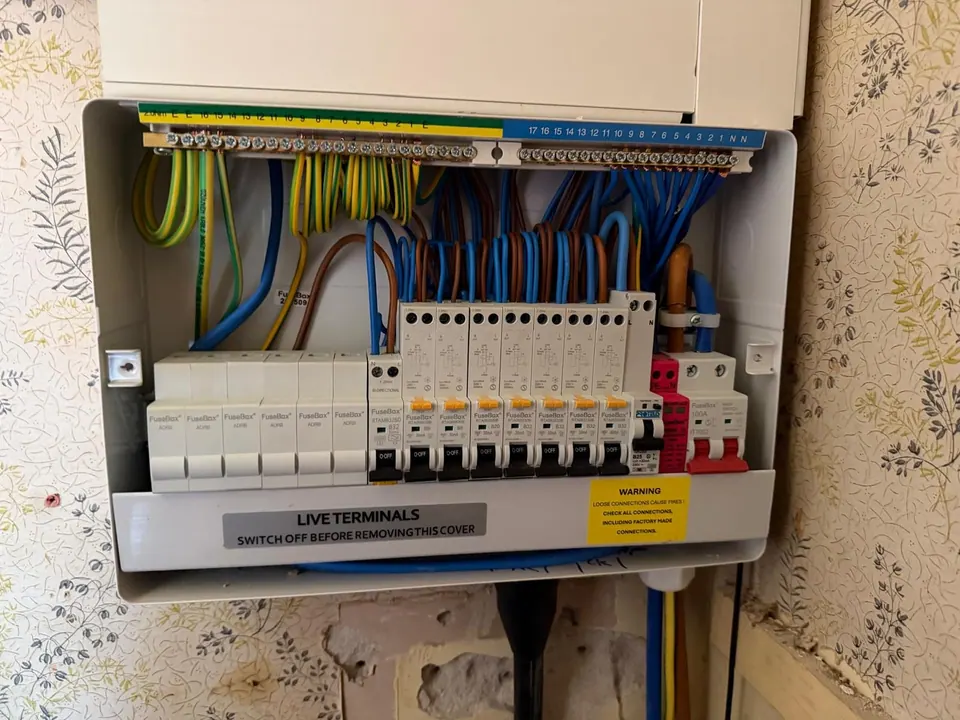
If a charger or battery means replacing the consumer unit with a modern one, that’s a separate job from the unlooping. Our guide to whether an EV charger needs a new consumer unit covers when it does.
How long unlooping takes
SSEN’s looped-service page gives no single lead time, but the published steps look like this:
| Stage | What the guidance says |
|---|---|
| Load check review | Under the ENA’s process, the network operator responds within ten working days where demand is under 100 A and the information is complete |
| Photos and site visit | SSEN checks its records and photos of the cut-out, fuse and meter position; clear photos speed things up, and a visit may follow |
| You and your neighbour | SSEN meets the landowners of both properties on site and secures land rights before work starts |
| The work | Supply off for safety, usually half a day or more depending on the digging; holes filled and the area restored |
| Your charger | Fitted only once any upgrade or unlooping is complete |
The remedial work is the variable part: the ENA says each home and its network must be assessed before an estimated time can be given. If you’re claiming an EV chargepoint grant as a renter or flat owner, GOV.UK says the chargepoint can’t be installed until OZEV confirms you’re eligible, a second go-ahead to wait for. After that, see how long the installation day itself takes.
How to tell if your supply may be looped
Look, but don’t touch. SSEN’s guide says that if the supply is looped, you’ll see two cables going into the bottom of the cut-out fuse. One cable means you either aren’t looped to your neighbour or you’re at the end of the loop. The ENA adds that loops sometimes leave from the top of the cut-out, and SSEN says an underground cable can make a loop hard to spot, so a look is a clue, not proof. For an overhead service, SSEN asks for a photo of where the cable meets your house, if it’s safe to take.
Good to know Two cables into the bottom of the cut-out point to a loop, but a single cable doesn’t rule one out.
Never open or handle the cut-out or meter. The ENA tells charge point installers never to touch or interfere with network equipment, or to open a cut-out. Electrical Safety First’s Best Practice Guide 4 (Issue 7.4, August 2026) says electricians inspecting a home should make a visual inspection only of the intake equipment, from the service cable and service head to the meter. Ofgem says meter tampering is illegal and dangerous, risking fire, explosion or electric shock.
If black substance is leaking from the fuse, don’t touch it: SSEN warns it may be hot. If the fuse holder is damaged or cables are exposed, stay away and call 105, which is free. If there’s an immediate risk to life, dial 999.
What we do if your supply looks looped
We check your supply capacity on the free survey. If it looks looped, the load check goes to SSEN before your charger is fitted, with the photos of the cut-out, fuse and meter position that SSEN asks installers for. SSEN decides on unlooping and arranges it, and the notification follows once the charger is in. We handle the network operator paperwork your installation needs as standard. It’s part of every home EV charger installation we carry out, including fitting EV chargers for homes in Poole, where SSEN runs the network too.
Looped supply: the short version
A looped supply shares one service cable between neighbours. It’s safe as it is, but SSEN checks it before a charger goes in and does any unlooping first, usually free for a typical home. A battery raises the same question. If you think you’re on a loop, look at the cut-out without touching it, and tell us. Book a free home survey and we’ll check your supply and handle the paperwork with SSEN.
Questions we're often asked
- Does sharing a cable with my neighbour affect my electricity bill?
- No. SSEN says your electricity use is measured through your own meter, so you're only charged for what your household uses, loop or no loop. What the shared cable limits is how much power is available to the two homes together, not how your bill is worked out.
- What if my neighbour won't agree to the unlooping work?
- SSEN says your project manager will help you explore alternatives, which can include a different cable route, and will try to keep delays and extra costs down. Because SSEN needs the landowners of both properties to agree before it starts, it pays to talk to your neighbour about your plans early.
- Can my supply be unlooped if I rent my home?
- Yes. SSEN says renters can have the work done and it will work with your landlord or housing provider to arrange access. Where you or your neighbour don't own the property or land, SSEN asks for the owner's name and contact details so it can agree the work with them.
- Can a load-limiting charger avoid the need to unloop?
- Not on its own. The ENA lets some homes use connect and notify with a device that caps total demand at 60 amps, but only where there's no issue with the existing connection, and it names a looped supply as one of those issues. SSEN still wants a load check before a charger goes onto a looped supply.
- Do I need to be at home when SSEN does the work?
- Yes, and so does your neighbour. SSEN needs both households there for any site visits and on the day of the work, because it needs access to its equipment and carries out safety checks on site. Expect the power to be off for half a day or more, too.