On-street EV charging in BCP: cables across the pavement, gullies and council bays (2026)
No driveway in BCP? Trailing cables aren't allowed, but a pavement gully, proposed council bays and a £500 grant can help with on-street EV charging.
Electrical ExchangePublished · Updated · 7 min read


The quick answer
Without a driveway in Bournemouth, Christchurch or Poole, on-street EV charging means one of four routes: a charging gully set into the pavement (BCP agreed a small trial in July 2025, and a gully needs the council's consent), public chargers, including new on-street bays proposed in 2026, charging at work, or a private bay if you have one. Trailing a cable across the pavement isn't allowed, even under a cover. OZEV's grant for households with on-street parking pays 75% of the cost of the charge point, up to £500, once the council has agreed to a channel.
No driveway? On-street EV charging in Bournemouth, Christchurch and Poole comes down to what BCP Council allows on the pavement outside your home, and the rules moved on in July 2025 and again on 21 October 2026. Trailing a cable across the footway isn’t allowed, even under a cover. A charging gully set into the pavement was approved for a trial in July 2025. New council charging bays have been proposed for residential streets. And a charger on your front wall may no longer need a planning application.
This guide is for BCP households who park on the street.
Your on-street EV charging options in BCP at a glance
| Option | Where it stands in BCP (October 2026) | Who it suits | Grant or cost |
|---|---|---|---|
| Trailing a cable across the pavement | Not permitted, even under a cover | Nobody | None: covers and mats don’t qualify |
| A charging gully (cable channel) in the pavement | Small trial agreed July 2025; needs council consent | Homes that can usually park outside | Up to £500 off the charge point. The 2025 trial terms put the gully at your cost, so ask BCP about its new channel funding |
| Council on-street charging bays | 146 bays at 33 locations proposed (ref P137) | Most of them open to anyone nearby | Nothing to install |
| Council car park and other public chargers | Running now, from 56p per kWh in BCP car parks, plus parking | Top-ups, or when nothing else works | Pay as you charge |
| Charging at work | Up to your employer | Commuters with parking at work | Employers can claim up to £500 per socket |
| A private bay, such as an allocated space at a flat | A home charger in your own space | Flat owners and renters with a space | Up to £500 from the renters and flat owners grant |
How many BCP homes rely on the street?
BCP Council’s July 2025 Cabinet report cited an estimate that 27% of households in its area rely on on-street parking. At the 2021 Census, 9.9% of BCP households lived in a terraced house. In Burton & Grange ward it was 28.9%, the highest of BCP’s 33 wards, and in Christchurch Town ward 23.3%, with another 26.7% in purpose-built flats. In Poole Town ward, 51.4% of households lived in purpose-built flats and 19.6% in terraces.
Not every terrace lacks a drive, so treat these figures as a guide, not a count.
Can you run an EV charging cable across the pavement?
Not in BCP. The council’s policy is not to permit cables trailed over pavements, including under a heavy-duty cable cover or overhead on a gantry. Its July 2025 report explains why: covers and mats form a small ramp that can trip pedestrians and is a risk to wheelchair and buggy users.
The law backs this up. Under the Highways Act 1980, placing a wire across a highway in a way likely to endanger people using it is an offence unless you’ve taken all necessary means to warn them (section 162), and fixing a cable over or across a highway needs the highway authority’s consent (section 178).
Good to know In BCP a cable can’t trail over the footway, even under a cover or a ramp. Any crossing has to go through a channel the council approves.
BCP’s charging gully trial, step by step
BCP’s Cabinet recommended a trial of charging gullies on 16 July 2025, and full Council agreed it on 22 July 2025, with no votes against. A gully is a channel set just below the pavement surface, so your cable sits out of the way of pedestrians and wheelchair users while the car charges.
The Cabinet report set out how the trial would work:
- Who: residents who had already asked for a gully, aiming for 6 to 10 installations.
- Permission: a licence under section 50 of the New Roads and Street Works Act 1991, with a £130 application and site inspection fee, as for a dropped kerb.
- Conditions: a council-approved gully type, a contractor accredited for street works, and indemnity insurance from the day work starts.
- Afterwards: a second inspection, then the resident maintains the channel.
Under the trial as agreed, the householder pays. Since that report, BCP has been paid £93,000 from the government’s 2025 to 2026 EV pavement channels grant, which funds councils to install channels, so ask BCP what it covers before you budget. The report estimated a full installation with a socket or charger at around £1,300 to £1,650 after the grant of the time, then capped at £350. It names three gully products trialled by other councils: Kerbo Charge, Charge Gully and Gul-e. A gully policy is due once the trial has run, so check with BCP before you plan around one.
Not sure which route fits your street? Ask us about a free survey of your home’s supply and where a charger could go.
What changed on 21 October 2026
Until 21 October 2026, the permitted development right for a wall-mounted charger only covered areas lawfully used for off-street parking. Without off-street parking, the government says, you could need up to three permissions: highway consent, planning permission and street works permissions.
A new planning order, SI 2026/1056, now extends the right in England to a wall charger anywhere within the curtilage of a house or block of flats, within limits:
- a dedicated charge point, not a standard plug and socket, and only one per house or block,
- mounted no more than 1.6 metres above the ground,
- on a wall immediately adjoining the highway, sticking out no more than 0.2 metres and leaving at least 1.5 metres of footway to the edge of the road,
- when charging, the cable must cross the footway in a pavement-embedded channel authorised by the highway authority, which here is BCP Council.
The right doesn’t cover conservation areas or the curtilage of a listed building. BCP says it has 48 conservation areas, including Christchurch Central, Purewell, and Stanpit and Fisherman’s Bank in Christchurch, and Ashley Cross in Poole. There, a charger serving the street still needs a planning application. Whatever the planning position, you still need the council’s highway consent and a Section 50 street works licence for the channel.
Good to know The new front-wall right doesn’t apply in conservation areas or to listed buildings, so check your road before you plan a charger on the wall.
The £500 grant for households with on-street parking
OZEV’s grant for households with on-street parking gives 75% off the cost to buy and install a charge point socket, up to £500. The maximum rose from £350 on 1 April 2026, when the home grants were extended for a final year. It goes towards the charger, not the gully, and you can apply if you:
- own or rent the home you live in, with adequate on-street parking and no private off-street parking,
- will install a permanent cross-pavement solution alongside the charger,
- have your highways authority’s permission, and declare you’ll get any planning permission needed,
- own or are responsible for an eligible electric vehicle.
The charger must not go in until OZEV confirms you’re eligible. The grant needs an installer on OZEV’s approved list and an eligible charger model, and the installer deducts it from your invoice, then claims it with photos of the channel and the charger. Our guide to EV charger grants covers the other schemes.
If you do have a private bay, such as an allocated space at a block of flats, there’s no pavement to cross, and the grant for renters and flat owners is the one to read.
New council charging bays on BCP streets
BCP is also putting public chargers into residential streets through the government’s Local Electric Vehicle Infrastructure (LEVI) fund, with a capital award of £1.447m, and has appointed a provider to install, operate and maintain them.
The first batch went to consultation as reference P137, from 17 July to 7 August 2026, proposing traffic orders for 146 charging bays at 33 locations. Ten locations, with 42 bays, are on BH23 roads: Chestnut Way, Clarendon Road, Kings Avenue, Manor Road, Park Gardens, Peregrine Road, Priory View Road, Stour Road and two stretches of Russell Drive. Others include Norton Way, Park Lake Road and Garland Road (BH15), Pottery Road (BH14) and Knowlton Road (BH17).
These are proposals: the council will now consider the comments and report on how to proceed. If you have no off-street parking and want a charger near you, BCP’s EV charging page explains how to put your street forward for the next phase.
Public and workplace charging in the meantime
Until then, it’s public and workplace charging. As listed by BCP in October 2026, its car park chargers cost 72p per kWh (rapid) and 56p per kWh (fast), plus any parking fee, and you can only stay in the bay while charging. BCP points drivers to ZapMap for every public charger in the three towns.
The gap with home charging is why kerbside charging appeals. BCP’s July 2025 report put off-peak home charging as low as around 7p per kWh, depending on tariff, against roughly 44p to 89p at public chargers.
Since 1 April 2026, the Workplace Charging Scheme has offered eligible employers up to £500 per socket, for up to 40 sockets, so it’s worth asking yours.
Good to know BCP’s car park chargers cost 56p per kWh on fast and 72p on rapid, plus parking: far above an overnight home tariff.
What we check at the house end
Whichever route you take, the charger end is electrical work. At a free survey, our team checks:
- your consumer unit, which the charger is wired back to on its own circuit,
- your supply, because a charger is a big new load,
- where the charger goes, which on a front wall now has to fit the height, projection and footway limits,
- the cable route from the consumer unit to the charger.
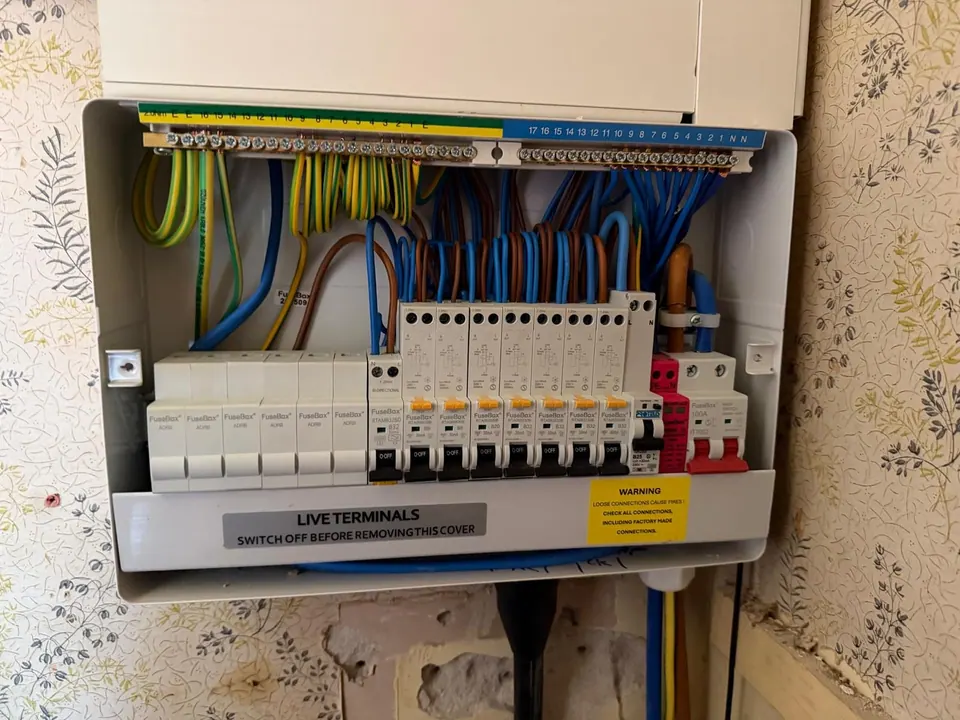
If your consumer unit needs bringing up to date, a consumer unit check or upgrade goes into the same quote. The government’s response restates that these installations should comply with BS 7671, the Wiring Regulations.
We’ll be straight about one thing: laying a gully is street works, and BCP’s trial requires a contractor accredited for street works. Our part is the home charge points we fit and the circuit behind them. The day itself runs like any charger fit, and what happens on installation day walks you through it.
On-street EV charging in BCP: your next steps
- Check whether your home is listed or in a conservation area. BCP publishes a conservation area map.
- Ask BCP about a gully for your street before you buy anything. The grant needs evidence of the council’s consent.
- Get a quote for the charger end from an installer on OZEV’s approved list, which the grant requires. The grant’s own steps put the quote before the application.
- Apply to OZEV, and only have the charger fitted once you’re confirmed.
From our base in Christchurch, we cover EV charging for Christchurch homes, home charger installs across Poole and Bournemouth. If you park on the street and want to know what on-street EV charging could look like for you, book a free survey and we’ll tell you plainly what applies.
Questions we're often asked
- Is it illegal to run an EV charging cable across the pavement?
- It can be. The Highways Act 1980 makes it an offence to put a wire across a highway where it's likely to endanger people, unless adequate warning is given, and BCP doesn't allow trailing cables at all, covered or not. A council-approved channel in the pavement is the permitted way across.
- Does the on-street parking grant pay for the gully?
- No. OZEV's grant covers 75% of buying and installing the charge point socket, capped at £500 since 1 April 2026. Under the trial terms BCP agreed in July 2025, the householder pays for the channel, its installation and upkeep, and the licence fee. BCP has since received government channel funding, so ask what applies now.
- Will a gully reserve the parking space outside my house?
- No. Both BCP's trial report and the government grant say a cross-pavement channel gives you no ownership of, or priority over, the space outside, so you may not always be able to park beside your charger. BCP notes exceptions can apply, such as a designated disabled bay.
- Do I need planning permission for a front-wall charger without a driveway?
- Often not, since 21 October 2026, provided the charger meets the permitted development limits on size, height and pavement clearance. The exceptions are conservation areas and listed buildings, where you'd still apply for planning permission. Highway consent and a street works licence for the channel are needed either way.
- What happens to the gully if I move house?
- BCP's trial terms cover this. The new owner or tenant has to take on responsibility for the gully, or the outgoing resident must remove it and make good the footway. Factor that into any sale, and keep the licence paperwork with your property documents.