Daikin Perfera vs Comfora: which wall unit suits your room? (2026)
Daikin Comfora vs Perfera from Daikin UK's own data: Perfera adds up to A+++, a motion sensor and Flash Streamer; Comfora is slimmer and nearly as quiet.
Electrical ExchangePublished · Updated · 8 min read

The quick answer
Both are Daikin wall units that heat as well as cool, run on R-32 and work with the Onecta app, and at the 2.5 and 3.5 kW sizes both run at 19 to 21 dB(A) on their quietest setting. The Perfera is the higher-spec unit: A+++ for cooling and heating at those sizes, a motion sensor, Flash Streamer air purification and Heat Boost. The Comfora is A++, simpler and slimmer, and Daikin pitches it for tight spots such as above a door. For a living room you use every day, the Perfera earns its extras; for a bedroom or a narrow wall, the Comfora usually does the job.
If you’ve settled on a Daikin wall unit and you’re weighing up Daikin Comfora vs Perfera, the gap between them depends on the size your room needs. The Perfera is the higher-spec unit, with A+++ labels at 2.5 and 3.5 kW, a motion sensor and Flash Streamer air purification. The Comfora is A++, simpler and slimmer, and Daikin pitches it for tight spots such as above a door. Every product figure here comes from Daikin UK’s own pages and data tables.
We fit Daikin, alongside Bosch, from our Christchurch base, and both units are on our list.
Daikin Comfora vs Perfera at a glance
Figures are for the 3.5 kW size unless a row says otherwise.
| Perfera | Comfora | |
|---|---|---|
| Indoor unit codes | FTXM-A | FTXP-N, FTXP-N9 |
| Largest size, cooling / heating | 7.1 / 8.2 kW | 7.1 / 8.2 kW |
| Energy class, cooling / heating | A+++ / A+++ | A++ / A++ |
| SEER / SCOP | 9.25 / 5.20 | 7.2 / 4.64 |
| Quietest setting, cooling / heating | 19 / 20 dB(A) | 20 / 21 dB(A) |
| Lowest output, cooling / heating | 0.9 / 0.8 kW | 1.3 / 1.3 kW |
| Heat output at −10 °C outside | 2.5 kW | 2.35 kW |
| Outdoor unit works, heating / cooling | Down to −20 °C / up to 50 °C | Down to −15 °C / up to 48 °C |
| Indoor unit, H × W × D | 298 × 804 × 252 mm | 286 × 770 × 225 mm |
| Refrigerant | R-32 | R-32 |
| Control | Onecta app over Wi-Fi, Alexa, Google Assistant | Same |
| Air cleaning | Flash Streamer, silver allergen, deodorising and dust filters | Silver allergen, deodorising and air filters |
| Airflow and sensors | 3D airflow, Comfort Plus, motion sensor, Heat Boost | 3D airflow, Comfort mode |
| Warranty | Same terms for both (see Warranty below) | Same terms for both |
Pairs compared: FTXM35A with RXM35A9, and FTXP35N9 with RXP35N9. Temperature limits are outdoor air temperatures from Daikin’s user guides; its data tables give the same heating limits as −21 °C (Perfera) and −15 °C (Comfora) wet bulb. Daikin marks some sizes as archived, including the Comfora’s 7.1 kW outdoor unit, so we confirm the current model at the survey.
Which models are we comparing?
The Perfera compared here is the FTXM-A, the “All Seasons” generation Daikin announced in March 2024. Daikin UK also lists a 1.5 kW CTXM-A for multi-splits and an FTXTM-A, in 3.0 and 4.0 kW, rated to heat down to −30 °C. The Comfora comes as the FTXP-N and an N9 version that keeps the compact body up to 5.0 kW. The digits give the size, so an FTXM35A is a 3.5 kW Perfera. Daikin’s UK manuals also list ATXM-A and ATXP-N codes, so check the full code on any quote.
What the Perfera adds
Both have Daikin’s 3D airflow, which swings air vertically and horizontally into the corners, plus silver allergen and titanium apatite deodorising filters. The Perfera adds:
- A two-area motion sensor, which sends air away from where people are and switches to energy saving after 20 minutes without movement, with a range of up to 7 m.
- Comfort Plus, a double flap that narrows the airflow and pushes it upwards, steering cold air away from people.
- Heat Boost, which Daikin says reaches the set temperature up to 14% faster than a reference Daikin system, on its own tests and on single splits only.
- Flash Streamer, Daikin’s air-cleaning technology, designed to help reduce certain airborne allergens and odours.
The Comfora counters draughts with a Comfort mode that stops warm or cold air blowing straight at you, and its remote has a 24-hour timer to the Perfera’s weekly one.
Efficiency: A+++ against A++, at the smaller sizes
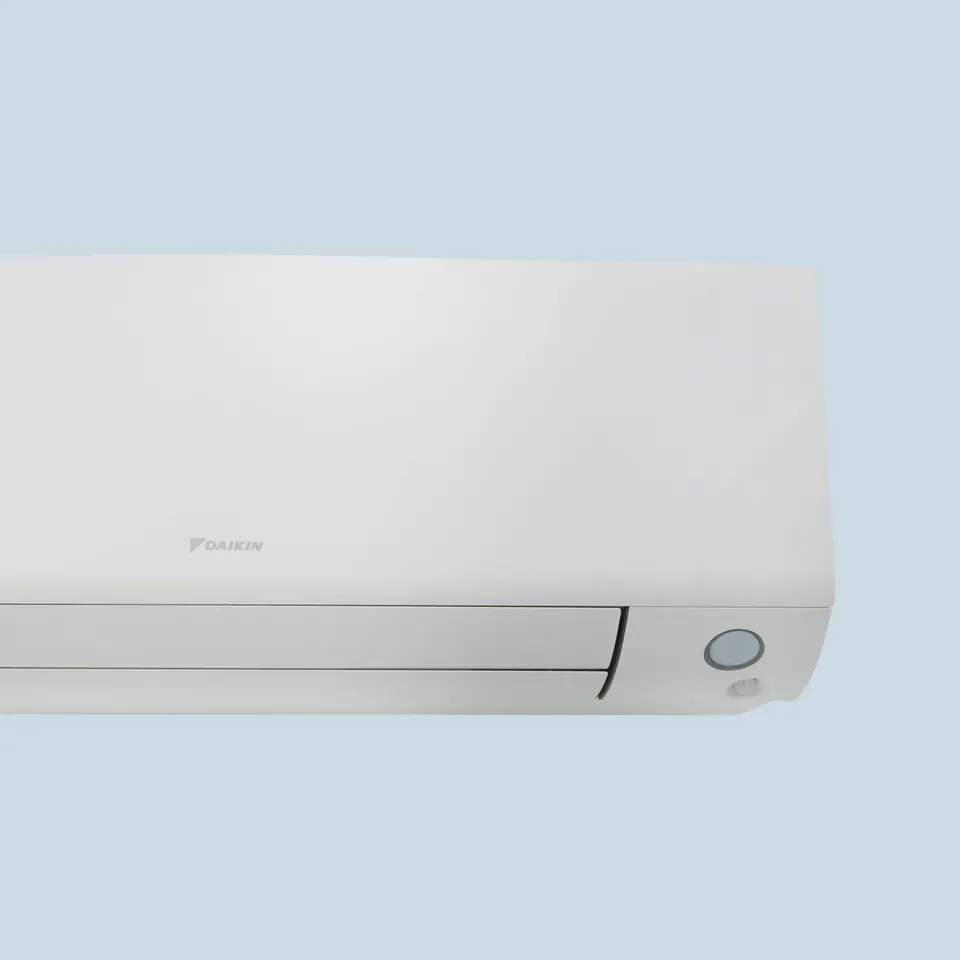
SEER (cooling) and SCOP (heating) are seasonal figures, measured across a year of changing temperatures and standby, and higher is better. At 2.5 and 3.5 kW the Perfera is a clear step up: a SEER of 9.47 and 9.25 and a SCOP of 5.20, against 7.2 and about 4.6 for the Comfora.
The gap closes as the units grow. At 5.0 kW the Perfera is A++ for cooling and heating, the Comfora A++ and A+. At 7.1 kW they’re almost level: a SEER of 6.2 each, a SCOP of 4.1 against 4.01, and the same A++ cooling and A+ heating labels. For a big room, you’re choosing on features, not efficiency.
Noise: 19 dB(A) is a small-size figure
Both are advertised at 19 dB(A) and both earn it, but only at small sizes on the silent setting. Daikin’s tables by size:
- 2.5 kW: 19 dB(A) for both in cooling; 20 (Perfera) and 21 (Comfora) in heating.
- 5.0 kW: 27 dB(A) for both in cooling; 31 and 30 in heating.
- 7.1 kW: 32 dB(A) for both in cooling; 34 and 33 in heating.
Daikin’s bedroom guide says experts recommend below 40 dB for unbroken sleep, which both clear easily at bedroom sizes below full fan speed (at full speed, Daikin lists 39 to 41 dB(A) for the 2.5 kW units). The bigger difference is outside: only the Perfera lists an outdoor-unit quiet mode, which Daikin says cuts its sound by 3 dB(A), worth having near a neighbour’s window.
Good to know At the 2.5 kW size, both wall units are rated at 19 dB(A) on their quietest setting, so for a bedroom the choice comes down to features rather than noise.
Heating through a Dorset winter
In our corner of Dorset, the heating side matters. For a Christchurch location, the Met Office’s 1991–2020 averages come from its Hurn station: about 56 days of air frost a year, a February average low of 1.6 °C and a July average high of 22.2 °C. For Poole they come from its Swanage station: about 14 days of air frost, a February low of 3.8 °C and a July high of 20.6 °C.
Neither unit is near its limit there. At 3.5 kW, Daikin’s user guides rate the Perfera to keep heating down to −20 °C outside and the Comfora down to −15 °C, and both defrost themselves when frost builds up. They differ on output in real cold: at −10 °C outside, the Perfera gives 2.5 kW of heat and the Comfora 2.35 kW.
Whether we’re fitting air conditioning around our Christchurch base or air conditioning for Poole homes, heating output deserves as much attention as cooling. Our guide to heating a room with air conditioning goes further.
Size and fitting: the Comfora’s above-door advantage
Daikin calls the Comfora ideal for above-door installation, and the numbers show why. Up to 5.0 kW, the FTXP-N9 is 286 × 770 × 225 mm and 9 kg, against 298 × 804 × 252 mm and 11.5 kg for the Perfera: 12 mm lower, 34 mm narrower and 27 mm shallower. Over a door frame, those millimetres count. At 6.0 and 7.1 kW both grow, to 298 × 997 × 292 mm (Perfera) and 295 × 990 × 263 mm (Comfora FTXP-N).
The outdoor units differ too. At 2.5 and 3.5 kW the Comfora’s RXP-N9 is 556 × 740 × 343 mm and 24 to 26 kg, against 610 × 923 × 367 mm and 36 kg for the Perfera’s RXM-A9, which can make it easier to place on a small patio or wall bracket.
Which one for which room?
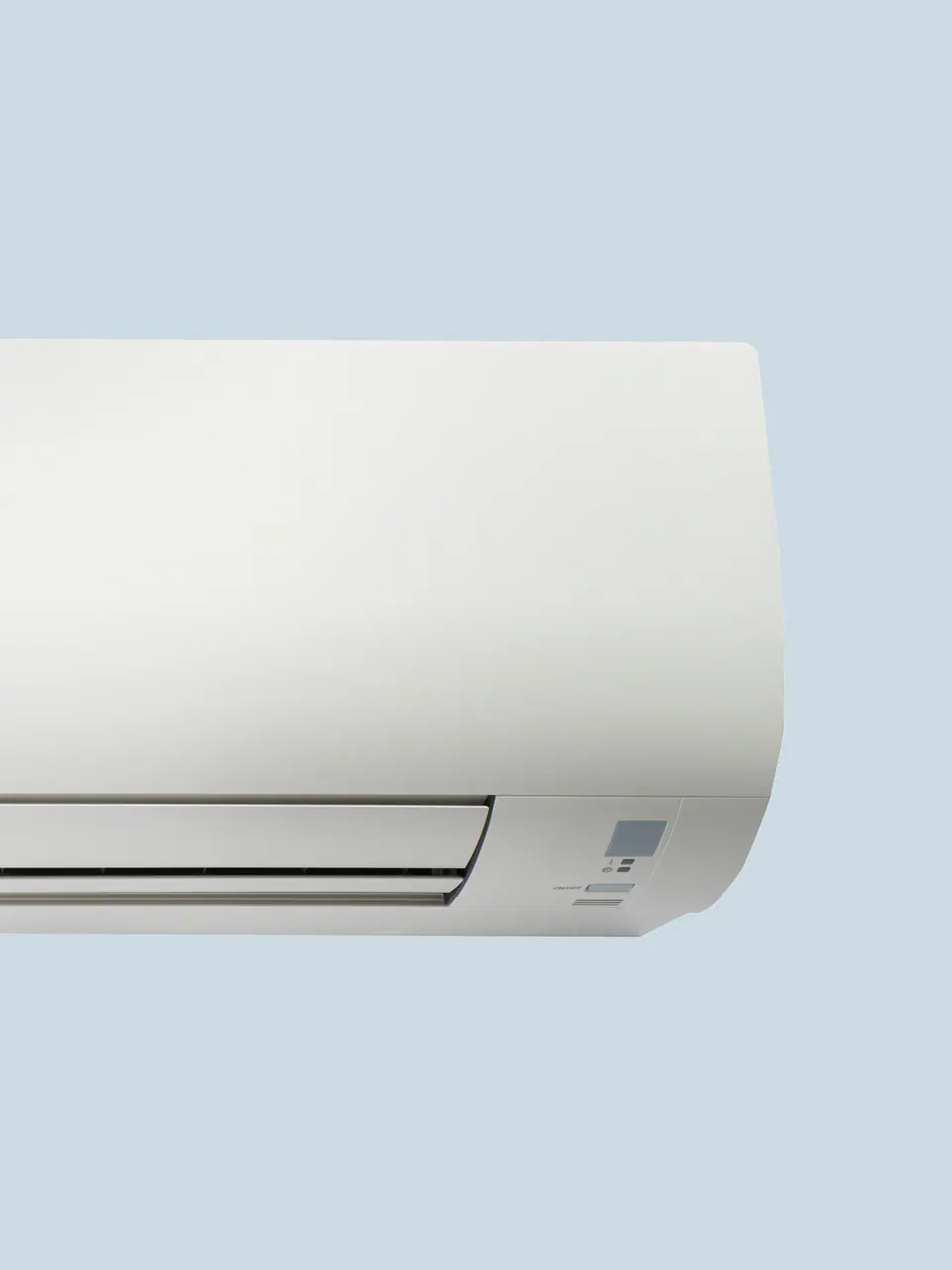
Daikin’s sizing guide works on about 0.1 kW per square metre: roughly 2 kW for a 20 m² bedroom and 3.5 kW for a 35 m² living room.
Bedrooms. Both are quiet enough, and both have a night set mode: set the off timer and the unit nudges the temperature up 0.5 °C in cooling or down 2 °C in heating. The Comfora usually does the job. The Perfera’s night set mode can’t run alongside its motion sensor, so choose it here for Flash Streamer if allergies or odours bother you. Our guide to choosing air conditioning for a bedroom covers placement.
Living rooms. This is the Perfera’s ground: the sensor keeps air off whoever’s on the sofa and saves energy when the room empties, Heat Boost warms it faster, and at 3.5 kW its A+++ labels count in a room you use every day.
Conservatories and garden rooms. Glass gains heat fast in the sun, and Daikin’s guide says large south- or west-facing windows often need 10–20% more capacity. If that pushes a glass room into the 5.0 to 7.1 kW sizes, the efficiency gap narrows, so choose on features and fit.
Can you mix a Perfera and a Comfora?
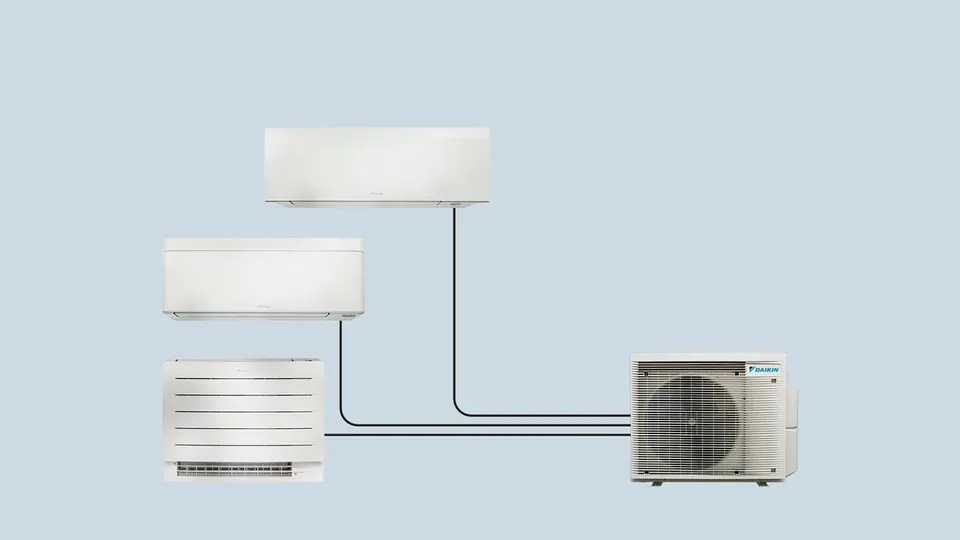
Yes, on a multi-split, which runs up to five indoor units from one outdoor unit; Daikin says you can combine different types. The Perfera and the Comfora FTXP-N9 both appear on its compatible lists for the 2MXM-A to 5MXM-A outdoor units, so a Perfera in the lounge and a Comfora in a bedroom can share one, each controlled separately in the Onecta app.
One rule: every indoor unit on it runs in the same mode, all heating or all cooling. Planning around how you use each room is how we approach every air conditioning installation.
How to switch a Daikin to heating
The remotes differ. On the Perfera’s (ARC466A86), press the Mode button until the heating symbol shows, then press on/off. The Comfora FTXP-N9’s remote (ARC480A78) has a button for each mode, so you press the heating one. Either way, heating can be set from 10 to 30 °C.
You can also change mode in the Onecta app or by voice through Alexa or Google Assistant. Or leave it on automatic: both switch between heating and cooling to hold the set temperature.
Choosing between the two? Ask us about a free survey and we’ll match the unit to the room.
Warranty: no difference between them
Daikin UK’s warranty page gives all residential customers a two-year guarantee as standard, plus six months’ free warranty for registering on its Stand By Me platform. Its five- and seven-year extensions are written for air-to-water heat pumps, and the list of products in its July 2025 policy includes neither wall unit. For products off that list, Daikin says the warranty terms are set by your installer’s cover.
So the warranty won’t separate these two. Ask any installer, us included, what cover comes with the job.
Daikin Comfora vs Perfera: which should you choose?
For a living room you use every day, or the best efficiency at 2.5 or 3.5 kW, the Perfera earns its extras. For a bedroom or a tight spot over a door, the Comfora does the job in a smaller box, inside and out.
We fit both, along with the rest of the Daikin range we install, for air conditioning across Dorset and the nearby Hampshire towns, and we check your room sizes, layout and outdoor unit position before recommending either. For a straight answer on Daikin Comfora vs Perfera in your home, book a free survey.
Questions we're often asked
- Does the Daikin Perfera have the Coanda effect?
- Not by that name. Daikin's current pages for the Perfera wall unit describe Comfort Plus instead: a double flap narrows the airflow and pushes it upwards, keeping cold air off people. That's close to how Daikin describes the Coanda effect elsewhere, as air directed along walls or ceilings rather than straight at occupants.
- Why does my Daikin stop blowing warm air on a frosty morning?
- Usually it's defrosting. In heating mode, frost can form on the outdoor unit, and Daikin's systems detect it and clear it automatically by reversing the refrigerant flow for a short time. The indoor unit stops blowing warm air until that's done. Daikin says it's normal and needs no call-out.
- Can I control a Perfera or Comfora from my phone?
- Yes. Both join your home wireless network and work with Daikin's free Onecta app, and both take voice commands through Alexa or Google Assistant. Each also comes with an infrared remote, so the app is optional. On the larger FTXP-N Comforas, a wireless adapter kit is a standard accessory.
- Can I add more rooms to a Daikin multi-split later?
- Daikin says you can start with the rooms you need now and add indoor units to the same outdoor unit later. How many it can take depends on the outdoor unit you start with, to a maximum of five, so mention any rooms you might add when we survey your home.
- Do the Perfera and Comfora use the same refrigerant?
- Yes. Both run on R-32, which Daikin's data tables list with a global warming potential of 675. Daikin says choosing an R-32 product cuts the environmental impact by 68% compared with R-410A.