Heating with air conditioning: can an air-to-air system warm your home all winter? (2026)
Yes, air conditioning can heat a home all winter. What a kWh of heat costs vs gas, oil and panel heaters at 2026 prices, plus cold limits and defrost.
Electrical ExchangePublished · Updated · 8 min read


The quick answer
Yes. Air conditioning that heats works as a heat pump, taking warmth from the outdoor air, and the Daikin and Bosch units we fit keep heating down to -15°C or -20°C outside. At the October to December 2026 price cap, a unit with a SCOP of 4.0 to 5.2 makes heat for about 5.1p to 6.6p a kWh, against about 8.7p from a gas boiler and, at September's heating oil price, 10.9p from oil. Size each unit for its room, expect short defrost pauses on frosty mornings, and plan hot water separately, because most systems don't heat water.
Heating with air conditioning works, and at October 2026 prices it can make heat for less than gas, oil or electric panel heaters in a Dorset home. A system that cools in summer can run the other way in winter, taking warmth from the outdoor air and blowing it into your rooms. Whether it carries you through a whole winter comes down to how each unit is sized, how it copes on frosty mornings, and what you do for hot water, which most systems don’t make.
Here’s how it works, what a unit of heat costs, and where it falls short.
How heating with air conditioning works
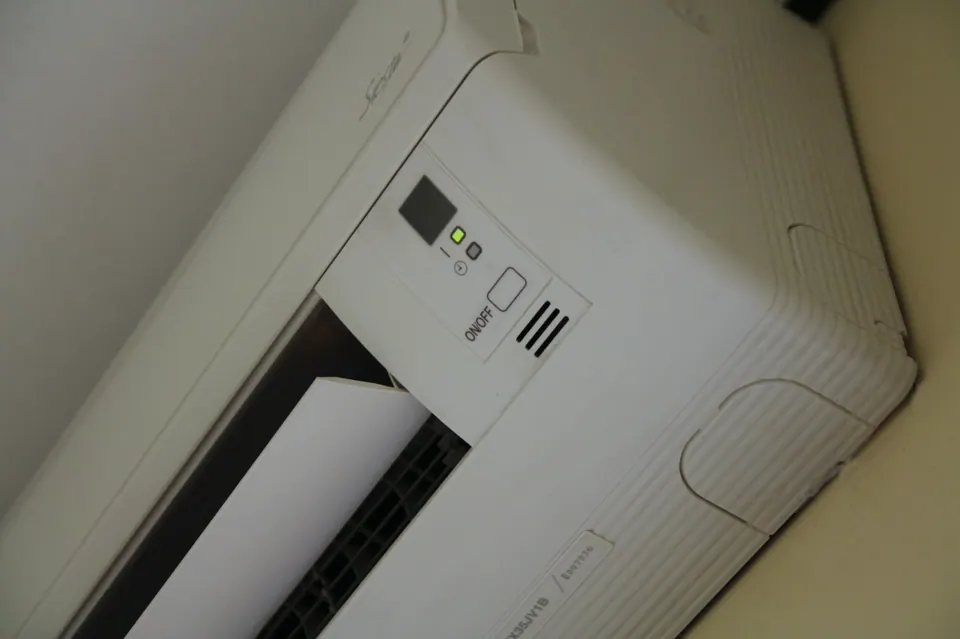
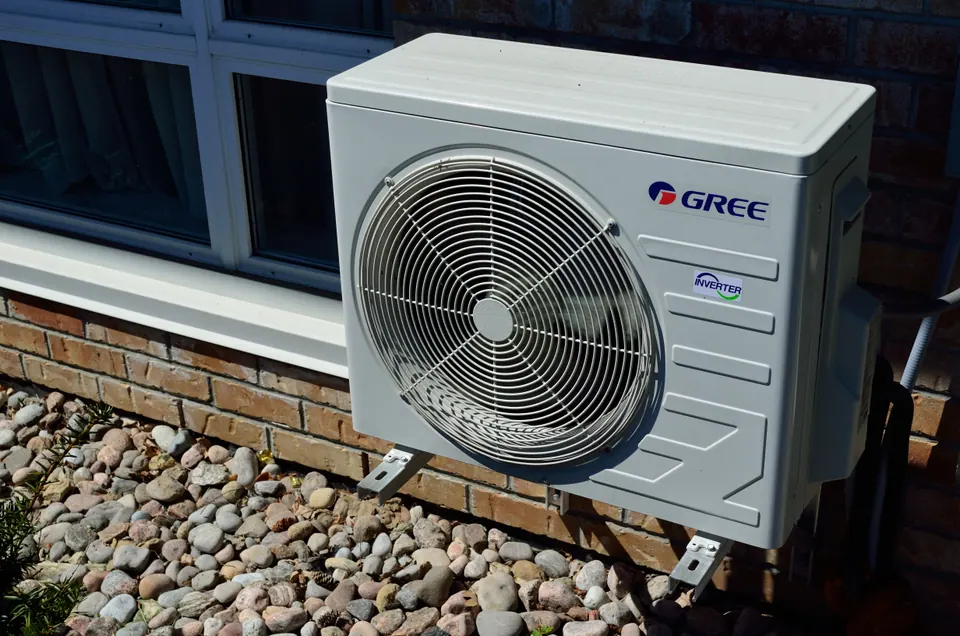
An air conditioner that heats is a heat pump. There’s usually one unit outside and at least one inside, joined by pipes carrying refrigerant. In heating mode the outdoor unit takes heat from the outside air, the refrigerant carries it in, and the indoor unit warms the room’s air. As the Energy Saving Trust (EST) explains, these systems warm the air rather than heating water in radiators, so they don’t need a wet central heating system.
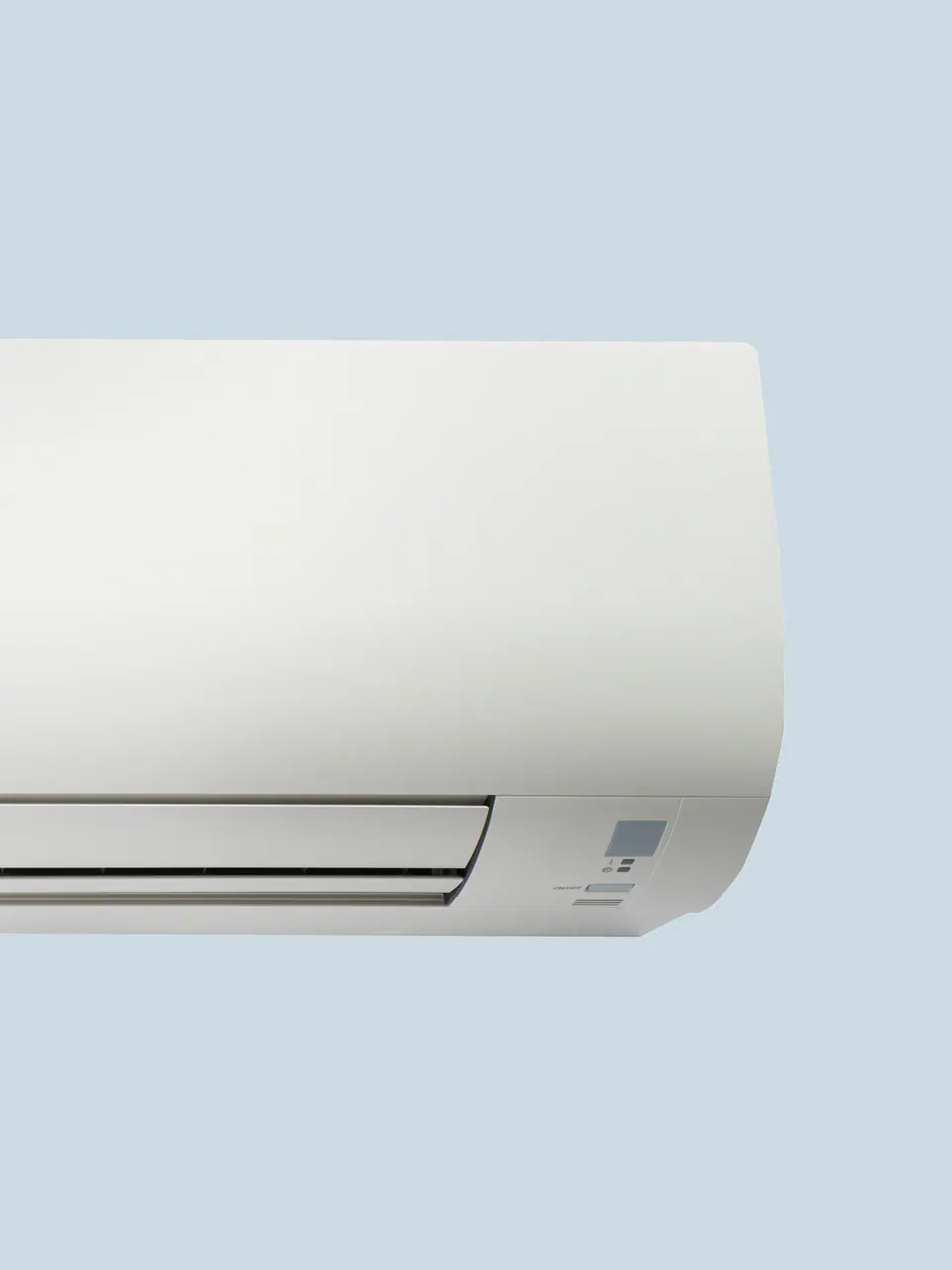
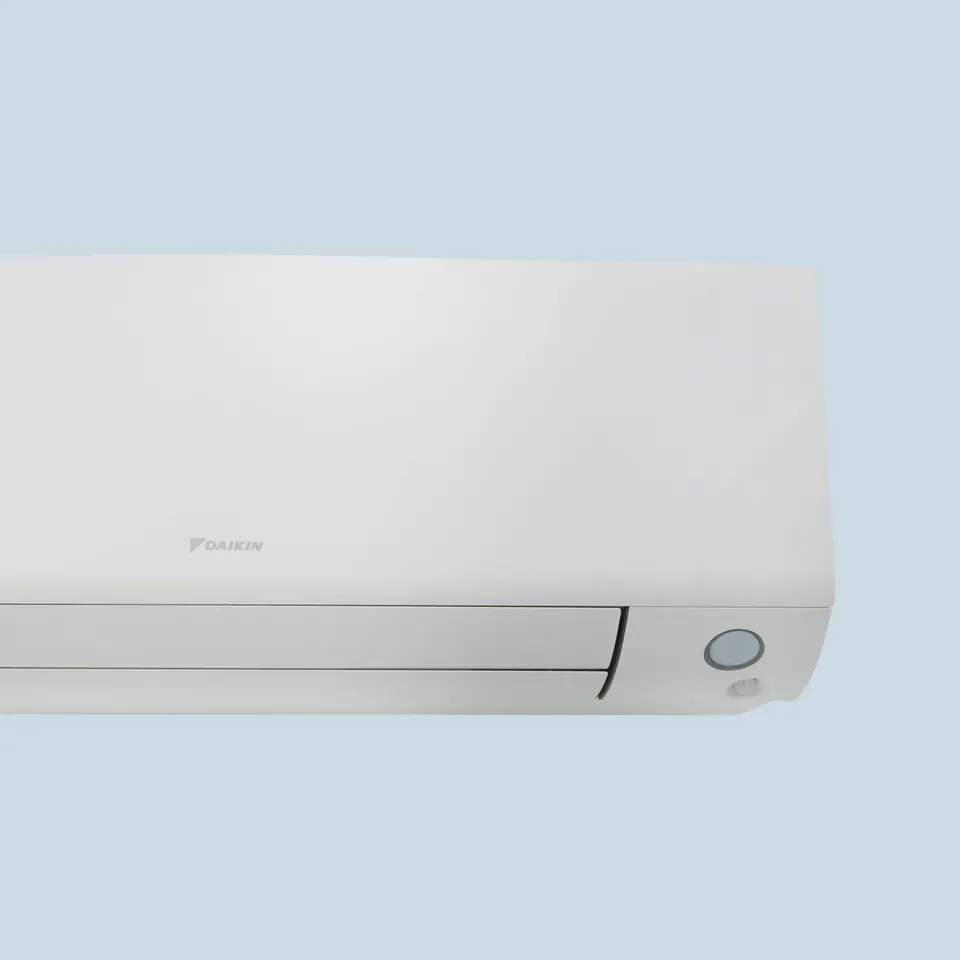
Not every air conditioner heats, but the EST notes that many can, and both makes we fit do: Daikin describes its Perfera wall unit as one that “heats, cools and purifies”, and Bosch sells the Climate 3200i for heating, cooling and dehumidifying.
What SCOP tells you, and the figures for the units we fit
COP is the heat a unit gives out divided by the electricity it uses, at one set of test conditions. SCOP, the seasonal coefficient of performance, works out that ratio across a whole heating season, so a SCOP of 4 means about 4 kWh of heat for every kWh of electricity.
The energy label turns SCOP into a letter: A+ covers 4.00 to 4.60, A++ 4.60 to 5.10, and A+++ is 5.10 or more, measured over a standard European season with rooms at 20°C and a design outdoor temperature of -10°C.
- Daikin: Eurovent’s independently certified figures give the 2.5 kW Perfera wall unit and its outdoor unit a SCOP of 5.20, rated A+++. There’s more on Daikin’s wall units, which we install.
- Bosch: Bosch lists the Climate 3200i single split at a SCOP of 4.0 to 4.2 depending on size, rated A+.
A label is a test result, not your living room, and the EST points out there isn’t much data yet on how air-to-air systems perform in UK homes. Use SCOP to compare units, not as a promise.
Running costs per kWh of heat, compared
Our sums divide each fuel’s price by how efficiently the system turns it into heat, using Ofgem’s averages for the October to December 2026 price cap (Direct Debit, England, Scotland and Wales) and the government’s typical UK heating oil price for September 2026.
| Heating | How it makes heat | Efficiency used | Fuel price | Cost per kWh of heat |
|---|---|---|---|---|
| Air conditioning, heating mode | Moves heat from the outdoor air into the room | SCOP 4.0 to 5.2 | Electricity, 26.32p per kWh | About 5.1p to 6.6p |
| Gas boiler | Burns mains gas to heat water for radiators | 92% | Gas, 7.97p per kWh | About 8.7p |
| Oil boiler | Burns kerosene to heat water for radiators | 91% | Kerosene, 102.3p a litre (about 9.96p per kWh) | About 10.9p |
| Electric panel heaters | Turn electricity straight into heat | 100% | Electricity, 26.32p per kWh | 26.3p |
The boiler rows use the minimum efficiencies England’s Approved Document L has set since 15 June 2022 for a replacement gas or regular oil boiler, figures its 2026 edition keeps when it takes effect on 24 March 2027, so they assume a boiler that meets today’s rules. Kerosene converts at 10.28 kWh a litre (government energy content figures), and BRE, which produced the government’s SAP rating method, has said an electric heater other than a heat pump gives 1 kWh of heat per kWh of electricity. Standing charges aren’t included.
These numbers will move: Ofgem’s figures for this period carry no VAT on electricity, a change running from 1 October 2026 to the end of March 2027, and kerosene swings hard. As a rule of thumb, at these prices air conditioning makes cheaper heat than a 92% gas boiler whenever its real seasonal efficiency is above about 3, and cheaper than oil above about 2.4.
Off the gas grid: why it matters in Dorset
Government estimates for 2024 put 42,506 of the 185,720 homes in the Dorset Council area off the gas grid, 22.9%, against 15.6% across England. In Bournemouth, Christchurch and Poole the figure is 14.3%.
The 2021 Census shows what many homes use instead. In the Dorset Council area, 8.7% of households heated with oil alone, against 3.2% across England, and across BCP 11.6% (20,210 households) relied on electric heating alone, against 8.7% in England. Oil has swung hardest this year: the government’s typical kerosene price was 53.5p a litre in February 2026, 104.1p in March and 102.3p in September.
Our page on air conditioning for homes across Dorset covers where an outdoor unit can go under the planning rules.
Good to know Nearly a quarter of homes in the Dorset Council area aren’t connected to the gas grid, which is why oil and electric heating are common here.
How cold is too cold?
Daikin’s user guide for its Perfera wall units gives a heating range down to -20°C outside on a single split, or -15°C with its multi-split outdoor units. Bosch rates the Climate 3200i to heat from -15°C to 24°C.
Typical Dorset winters sit well inside those limits. At the Met Office climate station at Hurn, about five miles north-west of our unit on Airfield Way, the average daily minimum over 1991 to 2020 was 1.8°C in January and 1.6°C in February.
What changes is efficiency. Here’s the certified COP for that 2.5 kW Perfera pair at each test temperature, and the cost of heat at 26.32p per kWh:
| Outdoor temperature | Certified COP | Cost per kWh of heat |
|---|---|---|
| 12°C | 7.95 | 3.3p |
| 7°C | 6.31 | 4.2p |
| 2°C | 5.23 | 5.0p |
| -7°C | 3.49 | 7.5p |
| -10°C | 3.20 | 8.2p |
Daikin’s guide also notes that the heating effect drops in the cold, so sizing matters: the EST advises that if heating is a main reason for the system, it should be designed and sized for your heating needs. We measure up each room at the survey and size every unit for the room it serves, as with every air conditioning installation we carry out.
Defrost cycles: the pause on frosty mornings
During heating, frost can form on the outdoor unit and cut its heating capacity, so the system switches itself into defrost to clear it. While it does, the indoor unit stops blowing warm air. Daikin tells owners who hear a flowing sound to wait 4 to 12 minutes, and says the white mist that can follow from the outdoor unit is moisture from the defrost turning to steam.
Frosty mornings are common here: Met Office records for Hurn average about 56 days of air frost a year over 1991 to 2020, most of them from December to February. A short pause on a morning like that is normal, not a fault.
Zoning: heat the rooms you use
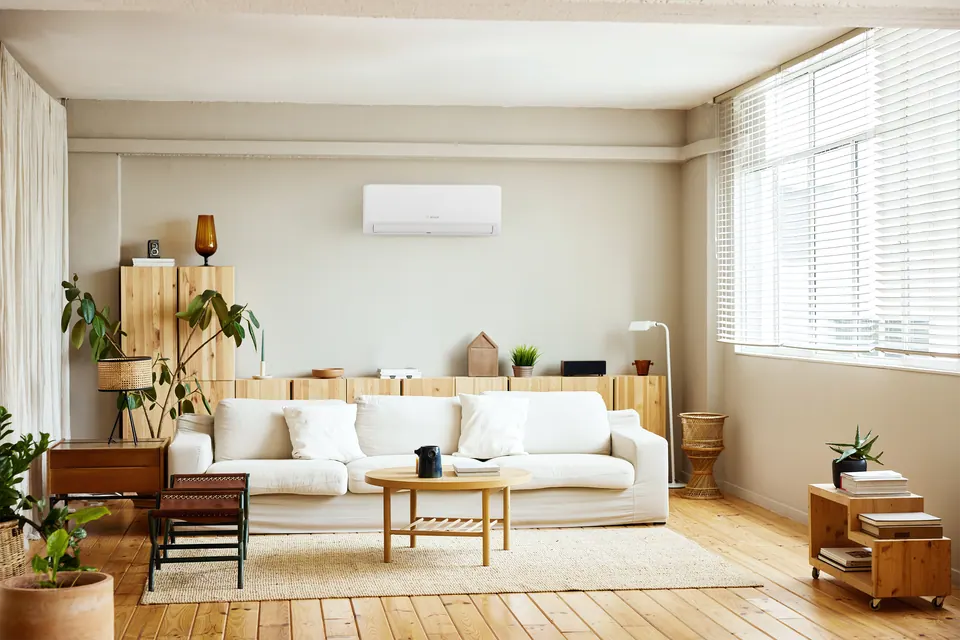
Each indoor unit heats its own room, so you can warm the lounge for the evening without heating empty bedrooms. A Daikin multi-split connects up to five indoor units to one outdoor unit, each controlled separately in the Daikin Onecta app. The Bosch Climate 3200i is a single split: one outdoor unit, one indoor unit.
Warming a whole house this way means an indoor unit in every room you want heated, and more units mean more pipework, which the EST says typically runs in a slim plastic channel around the upper edges of the room. If a bedroom comes first, our guide to quiet air conditioning for bedrooms covers the quietest units and where to fit them.
Where it beats radiators, and where it loses
Where it wins:
- No wet system: no boiler, water pipes or radiators needed.
- Room-by-room control, each unit to its own setting.
- Warm air within minutes: Daikin allows 1 to 4 minutes for a unit to warm up before the air starts to flow.
- Summer cooling from the same units.
- Cheaper heat at October 2026 prices: less per kWh than panel heaters, than oil above a SCOP of about 2.4, and than gas above about 3.
Where it loses:
- No hot water from most systems.
- No fresh air: it recirculates the room’s air, so you still need to ventilate.
- Noise: the EST says indoor units can be noisier than other heat pumps.
- A unit high on the wall in each room, with its pipe run.
- Defrost pauses on frosty mornings.
Wondering what it would cost to heat your home this way? Ask us about a free survey and we’ll size a system for the rooms you use.
Hot water needs its own plan
Most air-to-air systems don’t heat water. The EST lists the alternatives: a hot water cylinder with an electric immersion heater; an electric shower with point-of-use heaters for the taps; solar water heating backed by an immersion; or an air-to-air model that also heats a cylinder, which at least one manufacturer now makes. If you already have a gas or oil boiler, it can keep making your hot water while the air conditioning heats the rooms.
Running it from solar panels
Solar helps more with summer cooling than winter heating. Hurn averages 61 hours of sunshine in December and 67 in January, against 234 in July (Met Office, 1991 to 2020), with better overlap in spring and autumn: 128 hours in March and 113 in October.
If you have solar panels on your roof installed with us, we’ll design the air conditioning to make the most of your own generation. Heating also adds to what your home uses, so factor it in when working out a solar system’s size.
So, can heating with air conditioning see you through winter?
For the rooms it serves, yes. A properly sized system keeps heating far below Hurn’s average January and February nights of 1.6°C to 1.8°C, and at October 2026 prices it beats panel heaters on the cost of heat, oil once its real SCOP tops about 2.4, and gas above about 3.
We’ll look at your rooms, your current heating and where an outdoor unit could go, then tell you straight whether heating with air conditioning suits your home. Arrange a free home survey to get started.
Questions we're often asked
- Is air conditioning cheaper than central heating?
- Per unit of heat, it can be. At Ofgem's October to December 2026 rates, a system with a SCOP of 4 delivers heat for around 6.6p a kWh, where a gas boiler running at 92% works out at around 8.7p. Hot water, standing charges and how you use the system all shape the final bill.
- Can every air conditioner heat a room?
- No. It needs a heating mode, which means a reversible unit that works as a heat pump. The Energy Saving Trust notes that many air conditioning systems can heat as well as cool, and the Daikin and Bosch units we fit both do. Look for a heating capacity and a SCOP on the specification.
- Why does my air conditioner stop blowing warm air on frosty mornings?
- Usually it's warming up or defrosting. Daikin allows 1 to 4 minutes for a unit to warm up before air flows, and 4 to 12 minutes for a defrost, when the system melts frost off the outdoor unit by itself. A cloud of steam from the outdoor unit afterwards is part of the same process.
- Will air conditioning heat my home when it's below freezing?
- Yes, within its operating range. Daikin's user guide rates its 2.5 and 3.5 kW Perfera wall units to heat down to -20°C on a single split, and Bosch rates the Climate 3200i to -15°C. It works harder in the cold: the certified COP for a 2.5 kW Perfera falls from 5.23 at 2°C to 3.49 at -7°C.
- Does air conditioning bring in fresh air when it heats?
- No. It recirculates the air already in the room, so you still need to ventilate, just as you would with radiators. It does filter the air it moves: Daikin's Perfera includes an air purifying filter, and the Bosch Climate 3200i has washable filters and an ioniser to cut dust, allergens and odours.