myenergi eddi Review (2026): Settings, Boost and Spare Solar
myenergi eddi review: what its manuals and a year-plus independent test say about heater priority, boost timers, the app, batteries and the zappi.
Electrical ExchangePublished · Updated · 9 min read


The quick answer
The myenergi eddi sends spare solar to an immersion heater or other resistive heater, up to 3.68 kW, across two outputs in turn. Trusted Reviews gave it 4.5 out of 5 after testing it for more than 12 months. It earns most where the water would otherwise be heated by electricity. Where hot water comes from gas and your export rate is good, exporting can sometimes pay better, and myenergi itself says exporting by day can be more economical in certain situations. The current model has Wi-Fi built in, so the app needs no separate hub, and settings such as heater priority, boost timers and an export margin for batteries decide how well it works.
This myenergi eddi review goes beyond “it heats your water with spare solar”. It draws on myenergi’s own data sheet and manuals, plus an independent test of more than 12 months by Trusted Reviews, to cover the settings that decide how well it works, the kinds of boost, heating two tanks, and life beside a battery, a zappi or a heat pump. We fit the eddi, alongside the SolarEdge Hot Water Controller, from our base in Christchurch. For the basics, see our guide to what a solar diverter does.
The myenergi eddi at a glance
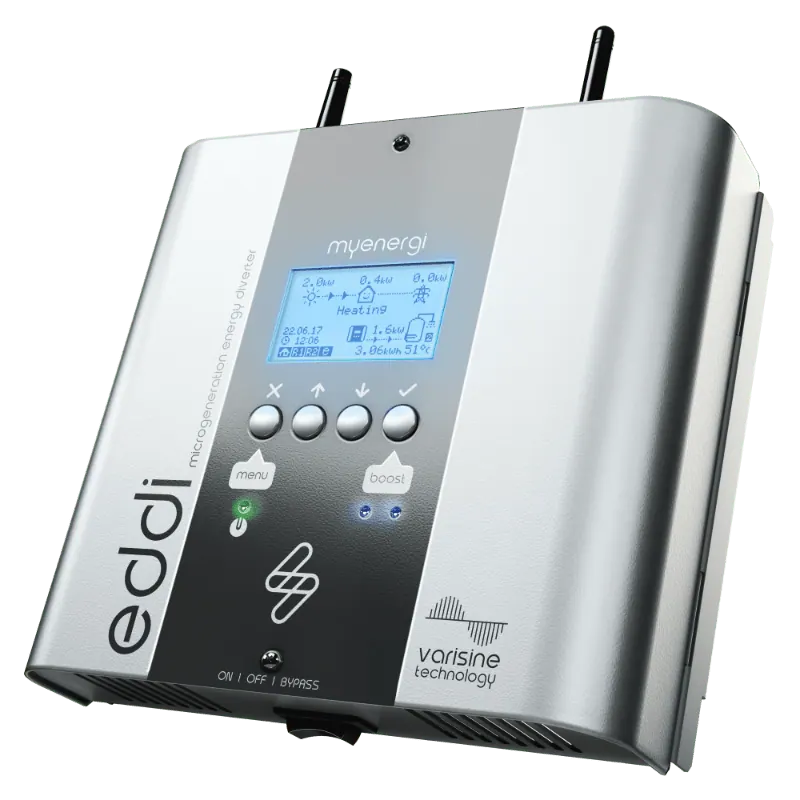
The current single-phase model is the eddi v2.1 (model EDDI-16A1P02H). From its data sheet and installation manual:
| myenergi eddi (single-phase) | |
|---|---|
| Rated power | 3.68 kW, 16 A, 230 V single-phase |
| Heater outputs | Two, powered one at a time, with a selectable priority |
| Power control | VariSine: the heater always gets a sine wave, and only the voltage changes |
| Standby use | 3 W typical |
| Connectivity | Wi-Fi, Ethernet and a built-in “vHub” |
| Size and weight | 220 x 205 x 87 mm, 4.3 kg, IP20 |
| Warranty | 3 years, with an optional 2-year extension |
| myenergi shop price, 23 October 2026 | £439 including VAT for the unit |
Three-phase homes have the eddi+, which myenergi rates for heating elements of up to 9 kW.
What independent testing found
Trusted Reviews tested an eddi for more than 12 months and scored it 4.5 out of 5 (published 7 March 2024). It found the eddi “works brilliantly”, cutting gas use and often delivering a full tank of hot water, though results depend on what you generate and use elsewhere. It praised the load balancing and a “powerful and reasonably easy app”. Its one listed drawback was that you may need optional components for the best results, such as the harvi wireless sensor or the Relay & Sensor Board. It noted that the Marlec Solar iBoost is a little cheaper and does much the same job.
How the eddi decides where spare solar goes
The eddi works from a sensor clipped around your incoming supply cable. When it sees power leaving the house, it raises the voltage to the heater until the export is soaked up, and it backs off when you start importing. In Trusted Reviews’ test, balance usually returned within 5 to 10 seconds after a passing cloud or a switched-on appliance. The heater’s own rating sets the ceiling: a 3 kW immersion draws no more than 3 kW, however much surplus there is.
The screen shows Waiting for Surplus, Heating, Max Temp Reached (the thermostat has opened, so surplus is exported) or Boosting. Stuck on Waiting for Surplus with 0 W of export on a sunny day? myenergi points to the grid sensor, and says only a qualified installer should open the unit.
Good to know The eddi only soaks up power that would otherwise be exported.
Two heaters, one eddi: setting the priority
The eddi has two heater outputs but powers only one at a time. You choose which comes first under Heater Settings > Priority. The priority heater gets the surplus until its thermostat opens; the eddi then moves to the second, checking back on the first every 15 minutes by default. A Hot Cancel Delay of 0 to 61 minutes can hold off that switch.
With a two-element cylinder, myenergi’s manual makes the top element the priority, because on a weaker day a smaller amount of properly hot water beats a whole cylinder of warm water. The second output could be another tank, an underfloor heating mat or a pool heater. Either way, the outputs take only purely resistive loads with mechanical thermostats: no electronic controls and no timers.
Manual boost, scheduled boost and Stop Mode
A boost runs the heater at full power whatever the surplus, so it can draw from the grid.
| Boost type | How it’s set | How it behaves |
|---|---|---|
| Manual boost | From the eddi’s main screen | Starts at 1 hour, adjustable; stops once the water hits maximum temperature |
| Scheduled boost | In the app, online or on the unit: up to four slots per heater | Rechecks every 15 minutes and reheats if hot water is used |
| Budget Charge | In myenergi’s online account, on a dynamic or flexible tariff | Boosts whenever the price drops below the level you set |
| Economy tariff boost | Needs the optional Relay & Sensor Board | Boosts whenever the cheap-rate supply is live |
Going away? Stop Mode, under Heater Settings, pauses your scheduled boosts until you turn it off. If two schedules clash, the higher-priority heater wins.
Got a gas boiler? Let the sun go first
If a boiler also heats your cylinder, myenergi’s advice is to time the boiler’s hot water for early morning or late evening, leaving room in the cylinder for the daytime surplus. With the Relay & Sensor Board, the eddi’s boost timer can switch the boiler’s hot water on an S-plan or Y-plan system too.
myenergi also notes that cylinders heated by a gas or oil boiler often have the immersion heater in the top half, so only about half the water can be heated electrically; a de-stratification pump, switched through the eddi’s optional Relay & Sensor Board, can bring almost the whole cylinder into play. We check your immersion heater on the survey.
The myenergi app, and whether you need a hub
The free myenergi app, for iPhone and Android, lets you monitor the eddi, change settings and set timers. Trusted Reviews called its dashboard “excellent”, with live energy flows and history by day, week, month or year, though in 2024 a price-triggered boost meant using myenergi’s website rather than the app.
The eddi v2.1 has a built-in “vHub”, so you don’t need a separate hub; earlier eddis without built-in Wi-Fi needed the optional myenergi hub for the app. The supplied clamp measures the grid only, so seeing your solar generation in the app takes an extra clamp on the inverter output. We show you round it at handover, and our guide to reading the Fox ESS app covers the battery side.
The eddi alongside a home battery
A battery and an eddi chase the same surplus, and myenergi says the two “can fight each other”. The fix depends on the battery:
| Battery type | What stops the eddi draining it |
|---|---|
| Standalone (AC-coupled) | An extra clamp on the battery’s cable, plus a Battery setting |
| Hybrid (panels and battery sharing one inverter, like the hybrid Fox ESS systems we fit) | The eddi can’t tell solar from battery power, so myenergi’s answer is an Export Margin of 50 W or 100 W, giving the battery first call |
An Export Margin keeps a trickle going out: with a 100 W margin and 1,000 W of export, the eddi uses 900 W. An Export Threshold waits until export passes the set level, then takes the lot. Both are installer settings, and without a battery myenergi says both can stay at 0 W. A boost, though, always draws from a battery unless it’s turned off, so settle these settings before adding a battery alongside your panels.
Pairing the eddi with a zappi
An electric car can’t start charging until around 1.4 kW is available, a requirement of the IEC 61851-1 charging standard, so smaller surpluses would be exported. myenergi suggests the eddi as priority 1 and the zappi as priority 2: the eddi diverts as soon as you export, and once it reaches 1.4 kW the zappi takes over, with the eddi dropping to zero until the zappi stops charging. Set them to equal priority and they share the surplus instead. Both run in one app; see the myenergi chargers and diverters we fit.
Heat pump cylinders
A heat pump cylinder needs the optional Relay & Sensor Board. Most heat pumps periodically use the immersion to heat the water hotter against Legionella; because the eddi mustn’t be back-fed, that signal goes to the board’s eSense input, and the eddi switches the immersion fully on. myenergi’s priority-control layout lets the immersion take small surpluses (its example is under 1 kW) and hands over to the heat pump above that, as the more efficient of the two.
Is the myenergi eddi worth it?
It depends on what a unit of spare solar is worth to you.
| Price per kWh | Figure | Basis |
|---|---|---|
| Typical export payment (Smart Export Guarantee) | Around 12p | Energy Saving Trust, October 2026 |
| Grid electricity | 26.32p average | Ofgem price cap, 1 October to 31 December 2026, Direct Debit |
| Mains gas | 7.97p average | Ofgem price cap, same period |
If grid electricity would otherwise heat your water, diverting wins easily. With gas it’s closer: a unit exported at 12p can be worth more than the gas it replaces. myenergi itself says that, with recent changes to export tariffs, it “may, in certain situations, prove to be more economical to export surplus generation during the day” and boost at night. Trusted Reviews makes a similar point.
At the 2021 Census, 11.6% of households in Bournemouth, Christchurch and Poole had central heating running on electricity alone (England: 8.7%); if that includes your hot water, the case is clearest. In the Dorset Council area, 8.7% relied on oil alone (England: 3.2%), and myenergi’s rule is that the dearer your energy, the greater the benefit.
It suits less well with no cylinder and no electric heating, a battery that already soaks up the surplus, or a heat pump cylinder without the extra board. If you’re still weighing up whether a solar power diverter suits your home at all, start there.
Good to know Diverting pays most where hot water would otherwise be heated by electricity; with gas and a strong export rate, exporting can sometimes pay better.
Fitting an eddi: what the manual expects
The manual says the eddi goes indoors, on a flat wall with space to breathe, fed from a dedicated 16 A circuit breaker or, where the heater is under 3 kW, a 13 A fused spur. Electrical connection work may only be carried out by a competent person, and myenergi recommends using an electrician. At the free survey we check your solar, your inverter’s make and your immersion heater, and most installations take a single visit. That’s the same near us in Christchurch as it is for the diverters for solar homes in Poole we fit.
The myenergi eddi in short
The myenergi eddi does its core job well, and an independent test of more than a year bears that out. Its value comes from the settings: priority for two heaters, boosts timed for cheap electricity, an export margin beside a battery, and the right order with a zappi. If you’d like to know whether a myenergi eddi would earn its place on your cylinder, book a free survey and we’ll look at your solar, your inverter and your immersion heater.
Questions we're often asked
- Can I use an eddi without solar panels?
- You can, on boost alone: scheduled boosts in a cheap overnight period, or a price-triggered Budget Charge on a dynamic tariff. Trusted Reviews concluded, though, that the eddi probably won't pay for itself unless you have your own renewable generation, such as solar panels or a wind turbine.
- Will my 3 kW immersion heater work with an eddi?
- Yes. The data sheet gives a maximum heater load of 3.68 kW, so a standard 3 kW element sits comfortably within range. The eddi varies what it sends up to the element's own rating, so on a strong day that heater simply runs flat out at 3 kW.
- Does boosting use electricity from the grid?
- It can. During a boost the element runs flat out, surplus or not, so whatever your panels aren't covering comes from the grid, or from a home battery unless the battery is switched off. Timing scheduled boosts for a cheaper tariff period keeps that top-up as cheap as possible.
- Will an eddi work with my existing solar inverter?
- myenergi says the eddi connects to any microgeneration system and that its VariSine control runs trouble-free with all inverters; it works from a sensor on your supply rather than a link to the inverter. We still check your inverter brand and immersion heater at the survey before recommending a diverter.
- How long is the eddi's warranty?
- Three years as standard, according to myenergi, with the option of an extended warranty adding two more years, which takes cover to five. Trusted Reviews reports the same: three years, upgradable to five. The full warranty terms are published on myenergi's website.