Air conditioning in a conservatory: what works all year round
Conservatory air conditioning that works all year is a split heat pump: it cools in summer and heats in winter. Options, sizing, siting and the rules.
Electrical ExchangePublished · Updated · 8 min read


The quick answer
A split air conditioner that runs as a heat pump is what works in a conservatory all year. It cools the room on sunny afternoons and heats it on frosty mornings, with the compressor in a unit outside. Pick a wall-mounted indoor unit if there's solid wall high up, or a floor-standing console if the room is mostly glass. Fans, blinds and portable units can take the edge off summer, but they're stopgaps rather than a year-round answer. Shade the glass first, then size the unit for the glass, not just the floor area.
If your conservatory is too hot to sit in on a sunny afternoon and too cold to use on a winter morning, conservatory air conditioning can fix both, as long as it heats as well as cools. A split system working as a heat pump does both jobs, with a quiet unit in the room and the compressor outside. Fans, blinds and portables can take the edge off summer, but they’re stopgaps, not a year-round answer.
Why conservatories overheat in summer and go cold in winter
Glass lets the sun’s heat in and your warmth out far faster than a wall does. Approved Document L of the Building Regulations, in force since 15 June 2022, puts numbers on it: the highest U-value (the rate heat passes through) allowed for a new wall on an existing home is 0.18 W/m²K, against 1.4 for a new window and 2.2 for a rooflight. At those limits, a new window lets heat through nearly eight times as fast as a new wall, area for area.
Our weather works both ends. The Met Office’s 1991 to 2020 averages for Hurn, a few miles north-west of Christchurch, give about 1,780 hours of sunshine a year, roughly a quarter more than the UK average, and an average July daytime high of about 22°C. They also show about 56 days a year with an air frost, most of them between December and February.
Conservatory air conditioning options compared
| Option | Cooling | Winter heating | Noise in the room | Installation |
|---|---|---|---|---|
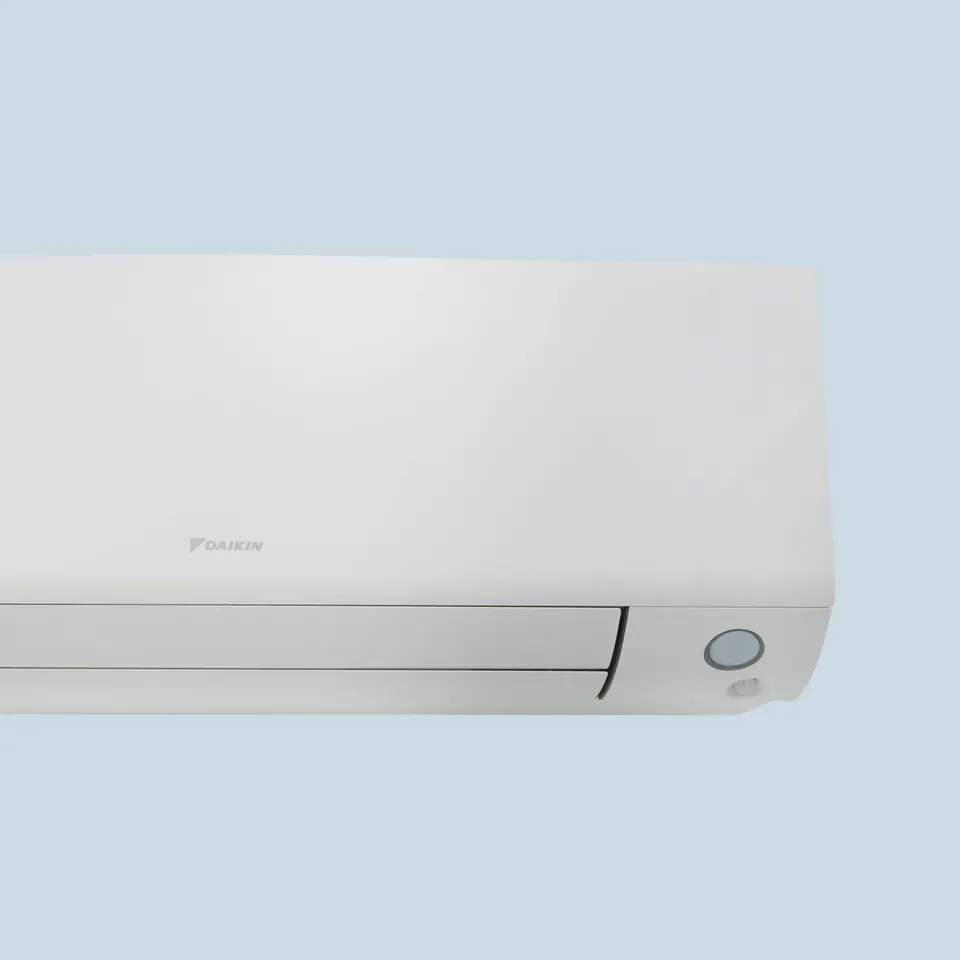
| Wall-mounted split heat pump | Yes | Yes | Quiet: Daikin quotes as low as 19 dBA | Two units, pipework through the wall, its own circuit |
| Floor-standing console (split) | Yes | Yes, and Daikin’s “warms the floor” | Quiet: Daikin quotes down to 19 dBA | As wall-mounted, but at floor level |
| Portable, single hose | Yes, but it blows room air outside | Only models built to heat | Compressor in the room | None, but the hose must go outside |
| Fans, blinds and solar film | Fans move air; shading and film cut the sun’s heat | No, and film cuts the winter sun too | Fans hum; shading is silent | Simple, though external blinds are a bigger job |
Wall-mounted or floor-standing: which suits your conservatory?
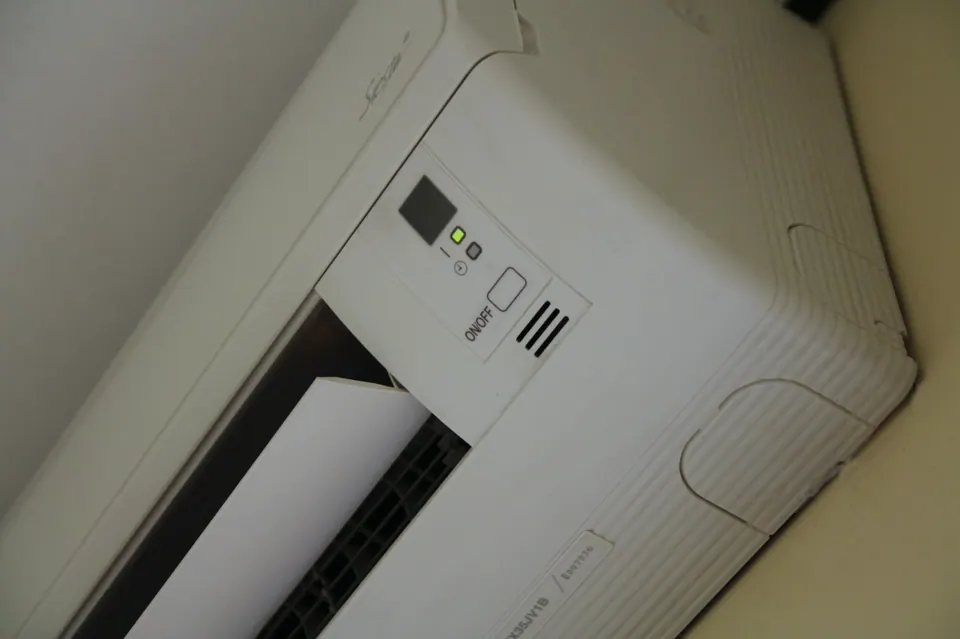
A wall-mounted indoor unit needs solid wall high up, which in a conservatory typically means the house wall above the doors through. Daikin describes its compact Comfora, 286mm tall, as “ideal for above-door installation”.
If your conservatory is glass down to a low wall all round, look at a floor-standing console. Daikin’s floor-standing Perfera is 600mm tall and, in Daikin’s words, “warms the floor for better heat distribution”.
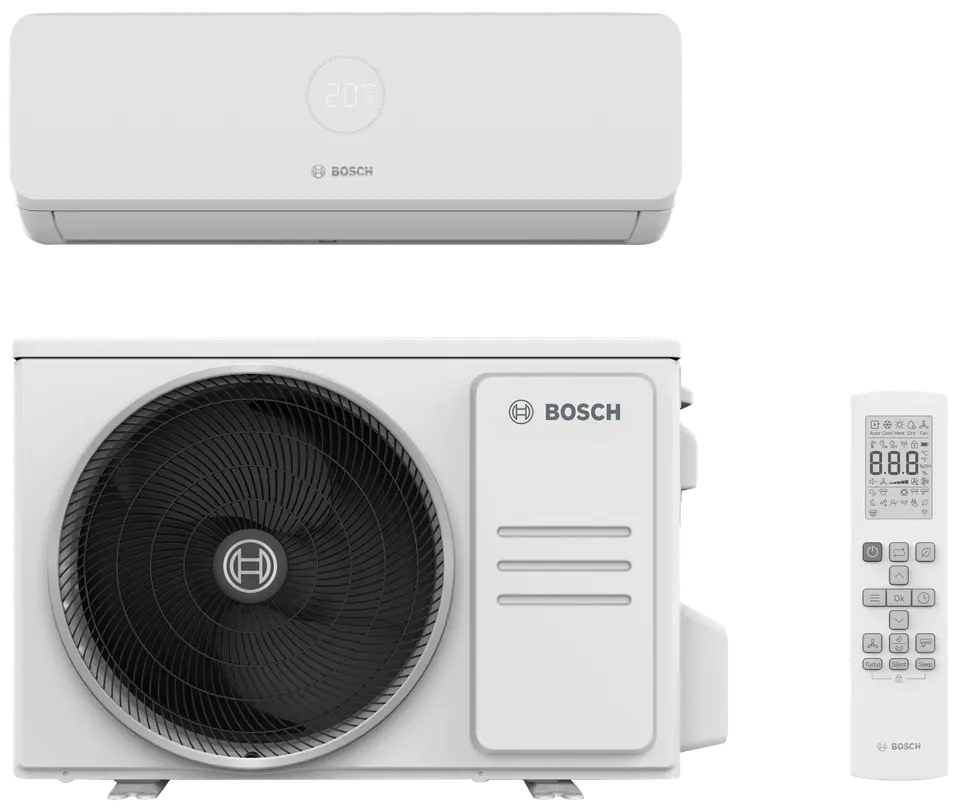
Daikin and Bosch are the two makes our team fits: compare the Daikin wall and multi-split ranges we fit with Bosch’s Climate 3200i.
Why a portable struggles in a glass room
A portable plugs in and needs no installer. The catch is how a single-hose unit works: the UK’s ecodesign rules define it as one that draws air “from the space containing the unit” and discharges it outside. Whatever goes out of the hose has to be replaced, and on a hot day that means warm air from outside finding its way back in. Its hose also needs a window or vent, awkward in a room of sealed glazing. For a few hot weeks a portable helps. For a room you want to use in January, it’s the wrong tool.
How to cool a conservatory without air conditioning
Start with shade, because it stops heat before it gets in. Approved Document O, the overheating rules for new homes, lists shutters, external blinds, overhangs, awnings and glazing that lets less of the sun’s heat through. Internal blinds and curtains “provide some reduction”, it says, but don’t count towards the rule. A Greater London Authority study of overheating in care homes found external shading usually works best.
Then ventilate. UKHSA’s hot-weather guidance says to open windows when it’s cooler outside than in, at night for example, and to use fans only when the air is below 35°C, as above that they can raise body temperature.
If your conservatory only overheats on a handful of afternoons, that may be all it needs. Air conditioning earns its place when you want the room comfortable on most days of the year.
Sizing: why a conservatory needs more than a room its size
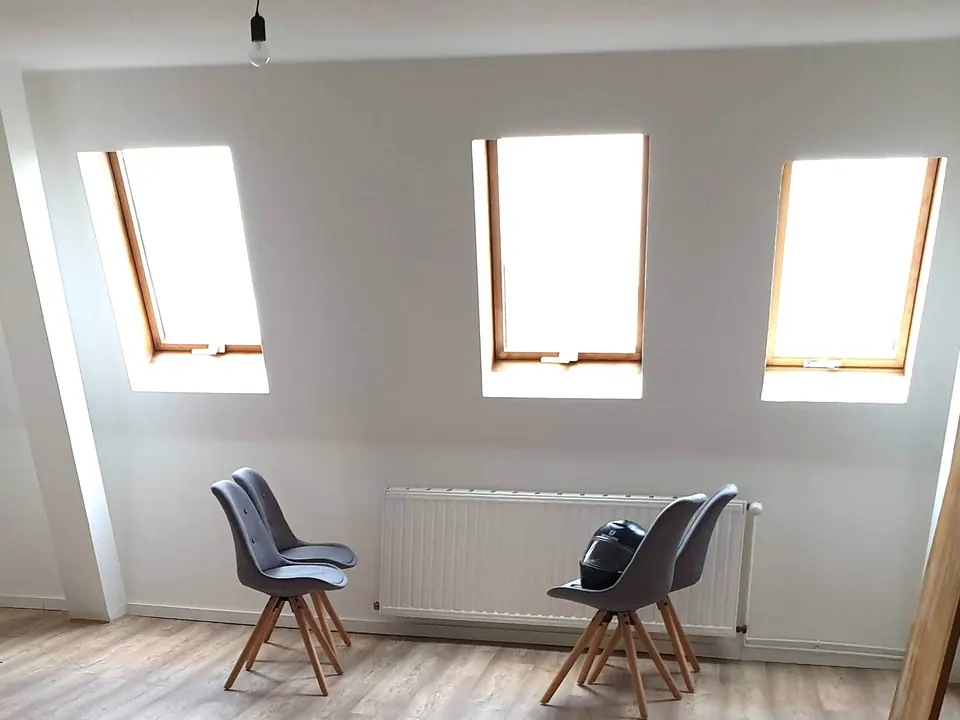
Floor area alone is a poor guide. The glass that lets heat out in winter lets the sun in during summer, so a conservatory needs more capacity per square metre than a room the same size indoors. How much more depends on the glass (roof included), which way it faces, its shading, and whether you want winter warmth as well as summer cooling.
That’s why every air conditioning installation we carry out starts with a free on-site consultation, with design and sizing to follow within 48 hours. Bosch’s Climate 3200i alone comes in sizes from 2.6kW to 7kW.
Want a bedroom done too? A multi-split runs both from one outdoor unit, and our guide to cooling a bedroom for a good night’s sleep covers the bedroom side.
Good to know Glass lets heat through nearly eight times as fast as a new wall, so a conservatory needs more capacity than a room of the same floor area.
Heating the conservatory in winter with the same unit
A heat pump moves heat in from the outside air rather than making it, which is why it’s worth running in winter. Bosch’s data sheet for the 3.5kW Climate 3200i gives a seasonal coefficient of performance (SCOP) of 4.2 for an average climate: over a heating season, about 4.2 units of heat for each unit of electricity. An electric heater, as a report for the government’s energy department (BEIS) puts it, “would deliver only one unit of heat for each unit of electricity consumed”.
Daikin rates its RXM-R outdoor units for heating down to -20°C outside, and Bosch calls its Climate 5000M multi-split “a fantastic way to heat” a conservatory “that gets cold in the winter”. That’s the thinking behind the air-to-air systems we fit, which heat as well as cool.
A conservatory overheats when the sun is out, which is when solar panels generate. If you have panels or a battery with us, we’ll design the system around your own generation; if solar is still on your list, count air conditioning in when working out how many solar panels you need.
Where the outdoor unit goes
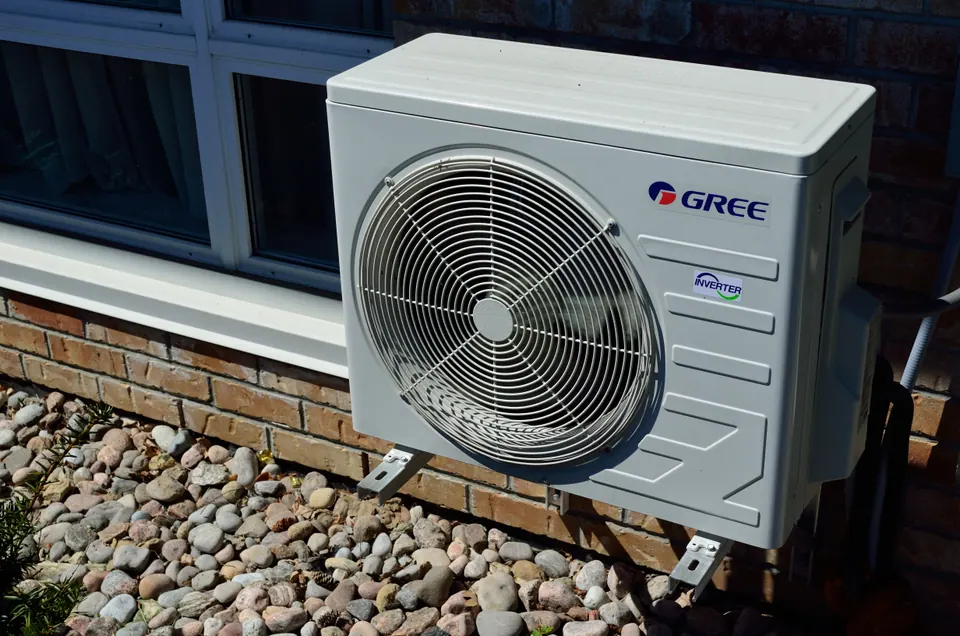
The outdoor unit holds the compressor, so its spot affects noise, performance and lifespan. Daikin’s installer guide for its RXM-R outdoor units rules out “sound sensitive areas (e.g. near a bedroom)”, warns that strong wind into the air outlet can cause “frequent frost acceleration in heating operation”, and says to keep the unit out of direct sea winds “to prevent corrosion caused by high levels of salt in the air”: for example behind the building, or else behind a windbreaker at least one and a half times its height.
That matters here: in Highcliffe, where the seafront sits up on the cliffs, the sea wind is part of choosing the spot, and our page on air conditioning for clifftop homes in Highcliffe covers siting there.
Condensate: water in summer and in winter
When it cools, the indoor unit takes moisture out of the air, and that water needs a drain route: Daikin’s checklist says to “make sure drainage flows smoothly”, or “condensate water might drip”. When it heats, frost and water form on the outdoor unit instead. Daikin says to set it on a base that drains, so ice can’t build up, and to keep drain water off footpaths so they don’t become “slippery in case of ambient freezing temperatures”. Settle the drain route before the unit goes up, especially beside a path or patio.
Do you need planning permission?
In England, often not. Since 29 May 2025, the permitted development right for air source heat pumps has covered units used for cooling as well as heating, which the government’s Warm Homes Plan says means “air-to-air heat pumps can also benefit”. Among the conditions in Class G of the General Permitted Development Order:
- the unit can’t be used solely for cooling,
- a house that isn’t detached can have one heat pump and a detached house two, counting any already there,
- the outdoor unit can be up to 1.5 cubic metres on a house,
- it can’t go on a pitched roof, or on a listed building or within its grounds,
- in a conservation area, it can’t go on a wall or roof fronting a highway, and
- it has to pass a standard noise calculation, MCS 020(a).
BCP Council says there are 48 conservation areas across Bournemouth, Christchurch and Poole, and its list puts 11 in the Christchurch area, among them Christchurch Central and Mudeford Quay. Our page on fitting air conditioning around Christchurch’s conservation areas covers the town.
Planning a conservatory unit? Ask us about a free survey and we’ll check the sizing, the outdoor unit’s spot and the drain run.
Building regulations and wiring
A ground-level conservatory of up to 30m², with glazing that meets the safety rules in Part K and the wall, door or window to the house kept in place, can be exempt from the energy efficiency rules if the house’s heating isn’t extended into it. In England, a unit with its own controls that heats only the conservatory doesn’t end that exemption: the Planning Portal lists “an independent heating system with separate temperature and on/off controls” among the conditions for it. If one outdoor unit will also heat rooms in the house, ask your building control body before work starts. For a conservatory that isn’t exempt, Approved Document L expects “independent temperature and on/off controls”, and a split unit has its own.
Daikin’s guide also calls for “a dedicated power circuit”, and in England a new circuit is notifiable work under Part P, so it has to be certified as meeting the Building Regulations.
So, which conservatory air conditioning is right for yours?
For a room you want to use all year, a split heat pump is the option built for both jobs: cooling on bright afternoons and heating on frosty mornings. Shade the glass first, size for the glass rather than the floor, and plan the outdoor unit’s spot and drain before anything goes up. Book a free survey and our team will measure up and size the right conservatory air conditioning for yours.
Questions we're often asked
- Is there a grant for conservatory air conditioning?
- Not for a unit that only serves the conservatory. Since 28 April 2026 the Boiler Upgrade Scheme has listed £2,500 towards an air-to-air heat pump that can heat the whole home on its own and replaces fossil fuel heating. The installer must be certified under MCS, and in October 2026 MCS says none is yet certified for air-to-air.
- Can the outdoor unit go on the conservatory roof?
- Not under permitted development if the roof is pitched, as Class G rules that out. On a flat roof, the unit must sit at least a metre from the edge. Otherwise it goes on a wall bracket or on the ground: Daikin says its outdoor units fit on a roof, a wall or in the garden.
- How noisy is conservatory air conditioning?
- Quiet indoors. Daikin quotes a sound pressure as low as 19 dBA for its Perfera wall and floor-standing units. Bosch's data sheet for the 3.5kW Climate 3200i gives a sound power of 56 dB for the indoor unit and 63 dB for the outdoor unit, so the louder part of the system is the one outside.
- Can one outdoor unit serve the conservatory and another room?
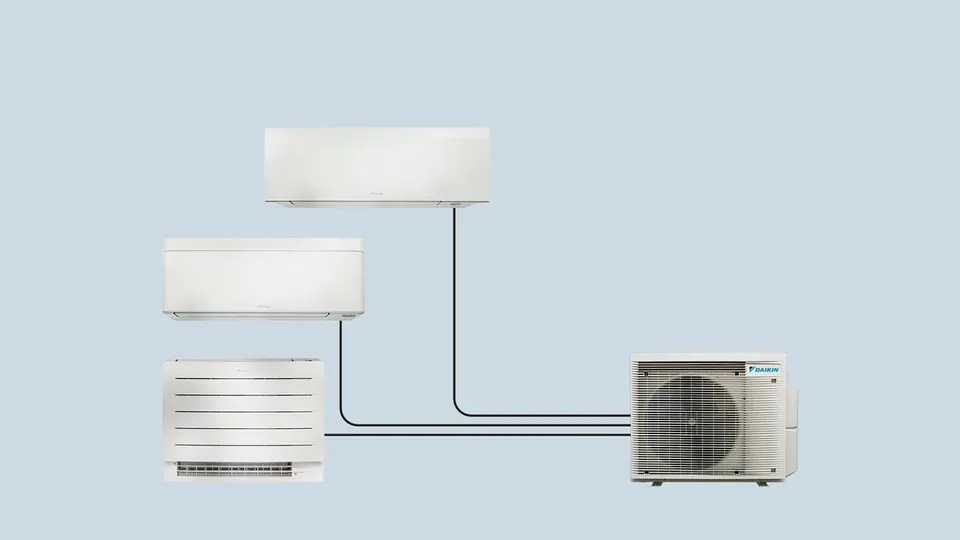
- Yes, with a multi-split. Daikin's connects up to five indoor units to one outdoor unit, each controlled separately in its Onecta app, and you can add rooms later. Bosch lists the Climate 3200i's indoor units as compatible with its CL5000M outdoor unit, which also takes up to five.
- How long does it take to fit air conditioning in a conservatory?
- After your free on-site consultation, we design and size the system within 48 hours, and the installation itself takes one to two days. The system is then tested, commissioned and handed over with a full handover pack, so you can start using it straight away.