Will the UK Need Air Conditioning? Heatwaves and Heat Health Alerts (2026)
What each heat health alert colour means, how fast UK summers are warming, how to keep cool in a heatwave, and when air conditioning makes sense.
Electrical ExchangePublished · Updated · 8 min read


The quick answer
Some homes will, but not every home, and not before the cheaper fixes. Heat health alerts run from yellow, when vulnerable people are at risk, to red, a significant risk to life even for the healthy, and June 2026 brought only the second red in England. Summer 2026 was provisionally the UK's warmest on record, and the Climate Change Committee says around 22% of homes would need active cooling, such as air conditioning, at 2°C of global warming. Follow the NHS advice on keeping cool first. Air conditioning makes sense for rooms that still overheat, and many split systems heat in winter too.
Will the UK need air conditioning? About 4% of homes in England already use it, and more will need it, though not every home and not before the cheaper fixes. In June 2026 England had only its second red heat health alert, summer 2026 was provisionally the UK’s warmest on record, and the Climate Change Committee (CCC) says around 22% of the UK’s homes would need active cooling, such as air conditioning, at 2°C of global warming. We’re based in Christchurch, so alongside the national picture, here’s what the figures say for Dorset.
What a heat health alert means, colour by colour
Heat health alerts come from the UK Health Security Agency (UKHSA), working with the Met Office. The current, impact-based system launched on 1 June 2023 and covers England. Each colour weighs how serious the health impacts could be against how likely they are, with likelihood rated from below 30% to above 90%. The core season runs from 1 June to 30 September, though alerts can be issued outside it.
| Colour | What UKHSA says it means |
|---|---|
| Green | No alert: conditions are likely to have minimal impact on health |
| Yellow | Heat unlikely to affect most people, but particularly vulnerable people, such as older people with several health conditions, are likely to struggle |
| Amber | Impacts likely across the whole health service, with potential for the whole population to be at risk |
| Red | Significant risk to life for even the healthy population |
The alerts are aimed mainly at health and social care staff and responders. Anyone can register for them by region, and the current status is shown on the UKHSA Data Dashboard. The Met Office’s extreme heat warnings are separate, come only in amber and red, and are written for the public too.
The temperatures behind each alert
There’s no automatic trigger, but UKHSA’s user guide (version 2.2, April 2025) lists the forecast temperatures it uses as a decision-making aid. Outside London, every region, Dorset’s included, uses the same figures:
| Impact level | Daytime maximum, outside London | Daytime maximum, London | Rise in deaths above expected levels |
|---|---|---|---|
| Very low | Below 27.0°C | Below 28.0°C | Not applicable |
| Low | 27.0 to 29.9°C | 28.0 to 31.9°C | 10% |
| Medium | 30.0 to 37.9°C | 32.0 to 39.9°C | 20% |
| High | 38.0°C and above | 40.0°C and above | 50% |
Warm nights count too: a night among the warmest 5% of summer nights adds to the assessment.
Why yellow alerts still matter
UKHSA’s own figures show why a yellow alert shouldn’t be shrugged off. Summer 2023 brought five heat episodes, two amber alerts and three yellow, and over 2,000 heat-associated deaths. The highest daily average, 129 deaths a day, came during a short yellow alert from 10 to 12 August 2023, more than in either amber spell.
The NHS lists those most at risk, including people aged 65 and over, children aged 5 and under, people who are pregnant or have serious long-term conditions, and people who live alone. At the 2021 Census, 29.6% of residents in the Dorset Council area and 21.6% in Bournemouth, Christchurch and Poole were 65 or over, against 18.4% across England. UKHSA’s 2025 report found the highest heat-associated death rates among people aged 85 and over.
Heat health alerts in Dorset and the South West
Alerts are issued by region, and Dorset falls in South West England. For summer 2025, UKHSA’s mortality report records amber alerts in every region during the June heat episode, in place until 23 June, then amber for the South West from 27 June to 2 July and from 11 to 15 July, and a yellow on 12 August.
In June 2026 the South West was one of the regions under the red alert, from 24 to 26 June.
The Met Office’s own heatwave test is separate: at least three days in a row at or above a county threshold. On its threshold map, Dorset’s is 26°C.
Good to know A yellow alert can still be deadly: in August 2023 a short yellow spell had the highest average daily toll of any alert that summer.
How many people die in UK heatwaves?
UKHSA estimates heat-associated deaths in England each summer:
| Summer | Heat-associated deaths in England |
|---|---|
| 2022 | 2,985, the record |
| 2023 | Over 2,000, across five heat episodes |
| 2024 | 1,311 |
| 2025 | 1,504, across five heat episodes |
| 2026, May and June only | 2,877 (interim) |
Of 2026’s deaths so far, 2,124 are linked to the eight-day June heatwave that brought the red alert, and final figures are due in early 2027. The CCC puts heat-related excess deaths in heatwave periods across the UK at 1,400 to 3,000 a year now, rising to 3,000 to 10,000 a year by 2050 at 2°C of global warming without further adaptation.
Is the UK getting hotter?
Yes. The UK’s highest temperature on record is 40.3°C, at Coningsby in Lincolnshire on 19 July 2022. The Met Office’s State of the UK Climate report on 2025, published in July 2026, found 2025 was the warmest year in a UK series running from 1884, that 2016 to 2025 was 1.33°C warmer than 1961 to 1990, and that days over 30°C in Greater London had more than quadrupled. Summer 2026 then provisionally beat 2025’s record, at 16.5°C against 16.1°C, and the Met Office says human-induced climate change made it around 130 times more likely.
Its UKCP18 projections, under a high-emissions scenario, put summers 0.9°C to 5.4°C warmer by 2070 than in 1981 to 2000, and hot spells over 30°C for two or more days running, about once every four years over the southern UK then, at about four a year. That’s one scenario, not a forecast.
Dorset summers: mostly warm, occasionally extreme
At the Met Office climate station at Hurn, north of Bournemouth and Christchurch, July days averaged a high of 22.2°C over 1991 to 2020, and July nights a low of 12.1°C: well short of Dorset’s 26°C heatwave threshold and the 27°C where UKHSA’s low-impact band begins. But averages creep up, and single months can stray a long way:
| Hurn, July | Average daily maximum |
|---|---|
| 1961 to 1990 average | 21.4°C |
| 1991 to 2020 average | 22.2°C |
| July 2022 | 24.7°C |
| July 2025 | 24.8°C |
| July 2026 (provisional) | 28.0°C |
July 2026’s provisional 28.0°C is the highest monthly average maximum in Hurn’s record, which starts in 1957, with just 0.6 mm of rain. The Met Office called it Southern England’s warmest July on record for mean temperature, with Dorset 3.5°C above average.
How to keep cool in a heatwave
Before you spend anything, the NHS advice on how to keep cool in a heatwave costs little:
- close windows, curtains and blinds during the day, and open them at night once it’s cooler outside;
- use electric fans, which can help while the temperature is below 35°C;
- have cold food and drinks, drink extra fluids, and avoid alcohol, caffeine and hot drinks;
- take a cool shower, or put cool water on your skin or clothes;
- if you have to go out, stay in the shade, especially between 11am and 3pm;
- check room temperatures where people at higher risk live and sleep, and check on them.
Heat exhaustion doesn’t usually need emergency help if the person can cool down within 30 minutes, the NHS says, but heatstroke is a medical emergency: call 999 if they’re still unwell after 30 minutes of resting somewhere cool, being cooled and drinking fluids, or show signs such as a seizure or loss of consciousness.
Good to know Closing curtains and blinds by day and opening windows at night costs little, and fans help while it’s below 35°C.
What the Climate Change Committee says about air conditioning
In A Well-Adapted UK (May 2026), the CCC says 92% of existing homes would overheat at 2°C of global warming in 2050 without further adaptation, with smaller homes, conversions and top-floor flats facing higher exposure. Natural shading and other low-cost passive measures may be enough in some parts of the country, but “we need to plan for more active cooling (such as air conditioning)”, especially in existing homes, and around 22% of the UK’s housing stock would require it. For the most vulnerable urban households, it suggests at least one cool room, and it expects that “most households will invest in cooling themselves”.
Few have so far: a University of Reading study of English Housing Survey answers from 2023 to 2024 found 4.3% of homes in England use air conditioning.
When air conditioning makes sense
Air conditioning earns its place in rooms that still overheat after shading and night-time airing. The Energy Saving Trust gives the same order: passive cooling first, then speak to an installer if your home still overheats. Typically, that means:
- top-floor rooms, given the CCC’s warning about top-floor flats (see our guide to cooling a loft conversion);
- bedrooms that stay warm into the night, where the quietest units for sleeping matter;
- one cool room for an older or vulnerable relative.
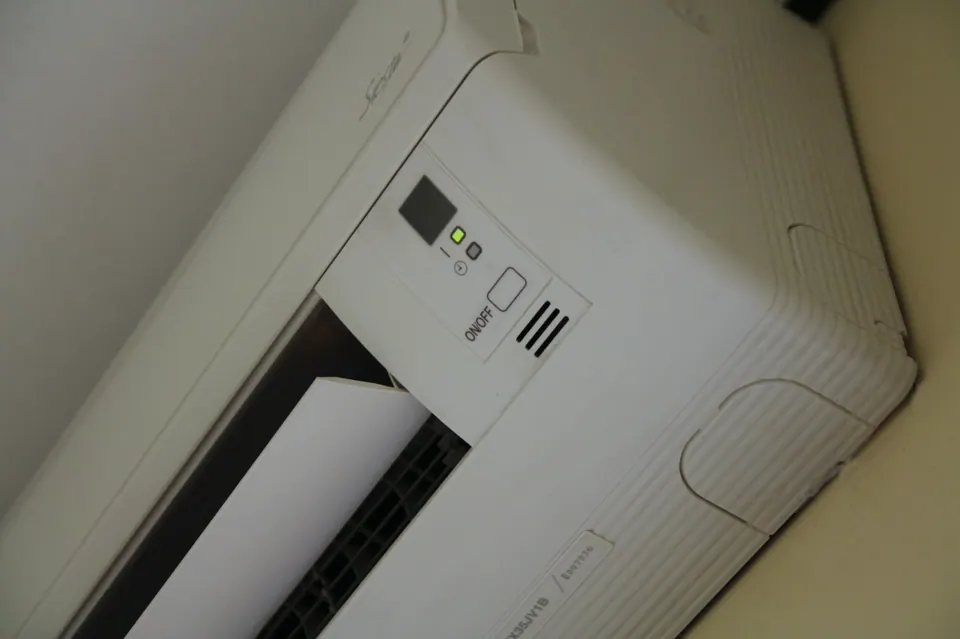
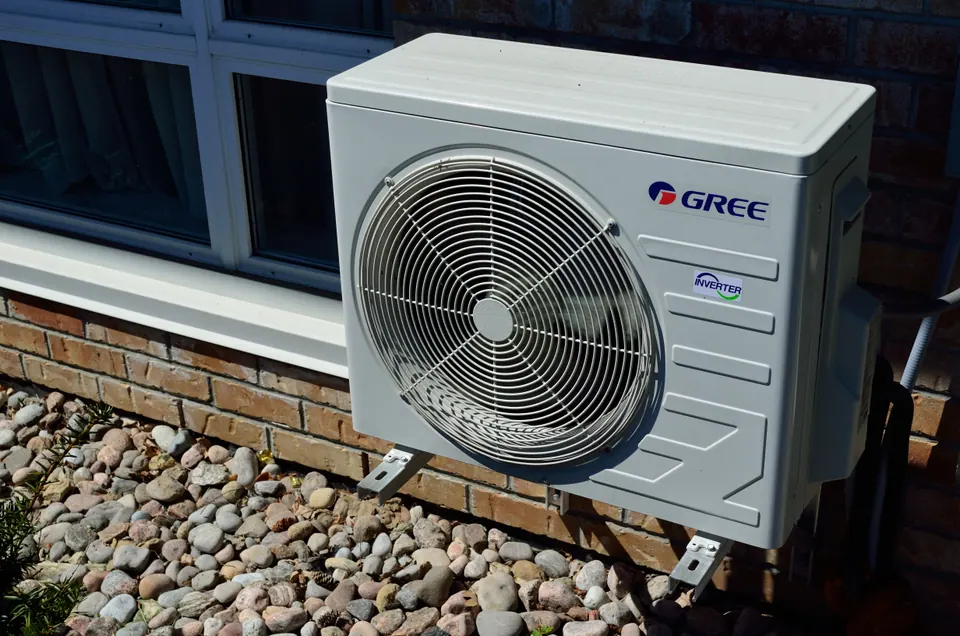
The CCC’s citizens’ panel expected people to buy portable units as “quick fixes”. A split system, with its compressor outside, is the longer-term answer, and it’s what our air conditioning installation work from Christchurch covers. In England since 29 May 2025, permitted development has covered an air-to-air unit that isn’t used solely for cooling and meets noise, size and siting conditions.
Good to know Air conditioning makes most sense in the rooms that still overheat after shading, night-time airing and fans.
A split system can heat in winter too
Many split systems run both ways. The Energy Saving Trust notes that “many systems can also provide heating”, and the CCC suggests support for heat pumps capable of cooling as well as heating. Both makes we fit do: Daikin’s Perfera wall units heat, cool and purify the air, and the Bosch Climate 3200i gives on-demand heating and cooling for individual rooms. Air-to-air systems don’t usually heat your water, so that stays with your current system.
Heating also counts for planning, as permitted development excludes a unit used solely for cooling. Whether it’s air conditioning we fit in Poole or heating-and-cooling systems across the rest of Dorset, we work out the right unit for each room at a free survey.
So, will the UK need air conditioning?
Some of it will. The average Dorset summer day stays well below the temperatures behind a heat health alert, and the NHS steps go a long way. But summers 2025 and 2026 each set a new UK record, the second provisionally, and the CCC expects more than one home in five to need active cooling at 2°C of warming. If a room in your home overheats whenever a heat health alert goes out, book a free survey and our team will look at whether a split system, for summer and winter, is worth it.
Questions we're often asked
- What is a heat health alert?
- It's a warning from the UK Health Security Agency, issued with the Met Office, that hot weather could harm people's health in England. The colour, yellow, amber or red, reflects how serious the effects could be and how likely they are. The main season runs from 1 June to 30 September.
- What does an amber heat health alert mean?
- UKHSA calls amber its enhanced response level. The effects of the heat are expected across the whole health service, and the wider population, not only vulnerable groups, could be at risk, so a coordinated response may be needed. It's a sensible moment to check on older relatives and neighbours.
- How hot does it have to be for a heat health alert?
- There's no single trigger. UKHSA and the Met Office weigh likely impacts against their likelihood, but the decision aid in the user guide starts its low-impact band at a daytime maximum of 27°C outside London and 28°C in London, with medium from 30°C (32°C in London). Very warm nights count too.
- Do fans help in a heatwave?
- Up to a point. The NHS says electric fans can help while the temperature is below 35°C. Beyond that, lean on its other advice: stay out of the heat where you can, keep curtains and blinds shut through the day, and cool your skin or clothes with water.
- How often has England had a red heat health alert?
- Rarely. UKHSA says the red heat-health alert triggered by the eight-day heatwave of 21 to 28 June 2026 was only the second time the highest level had been issued in England. On interim figures, it links an estimated 2,124 deaths to that heatwave.